
Page • Reliability, Operations and Management, Standards Development Building on a foundation of analysis capabilities, methods, and industry partnerships established in the Continuous Reliability Enhancement for Wind Database and the Blade Reliability Collaborative, and incorporating Sandia’s high-performance computing resources and expertise, this work fosters the emergence and establishment of standards that influence...
Search
Renewable Energy
Page • Renewable Energy Research that advances renewable energy technologies Sandia National Laboratories has performed advanced research in renewable energy since the 1970s. The more than 100 researchers in our program work to reduce the cost and improve the resilience and reliability of renewable energy technologies. Our research builds on many of...
Reports
Page • DateTitleReport No.Author(s)Links2025Direct Transfer Trip With Distributed Energy Resources,and AlternativesSAND2025-01668OMichael E. RoppView report2023Self-healing, self-assemblingislanded power systems using only local measurementsSAND2023-09936RMichael E. Ropp, Olga Lavrova, Matthew J. Reno, Elijah Silva, McKendree A. Densel,Lara N. Kassabian, Milan Biswal, Ada Ramoko, Satish J. RanadeView report2023Features and Limitations of Cell Phone Mobility Data for Disaster...
Research Capabilities
Page • Key Capabilities Code Development Sandia National Laboratories develops and maintains open source code for a wide range of marine renewable energy applications, including resource assessment, environmental effects analysis, device performance, hydrodynamic response, extreme conditions, and others. Open source code development is an ongoing area of research in Sandia’s Water Power Technologies...
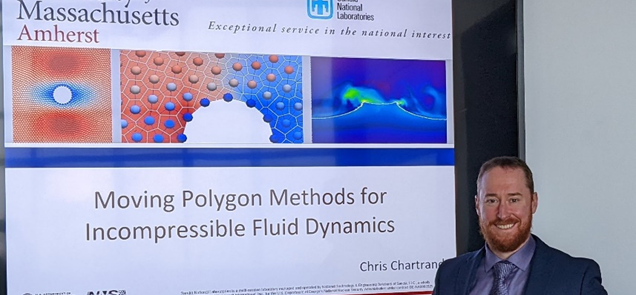
Researcher makes the most of Sandia’s educational opportunities
News Article, April 13, 2022 • Sandia Water Power program researcher Chris Chartrand recently completed his PhD in Mechanical Engineering thanks to educational opportunities offered through Sandia National Laboratories’ University Education Programs. Sandia offers these benefits to build the professional capabilities of the Laboratories’ employees and designs individual programs to support special technical talent acquisition, workforce...
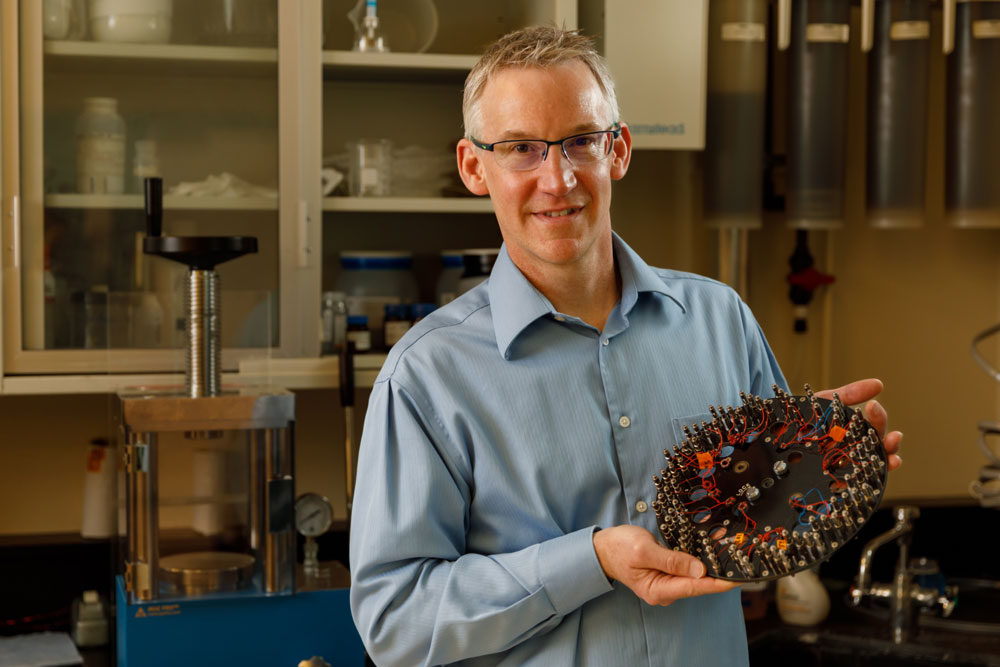
Researcher wins distinguished achievement award for vehicles’ “electrification-enabling” research
News Article, June 4, 2024 • While electric vehicles (EVs) are becoming more common, additional research and development is needed to reduce their cost and increase their performance — which is essential for increased consumer adoption. In particular, improved materials for EV motor components and inductors are considered to be one viable pathway to help achieve...
Researchers share HyBlend Phase I results and progress at H2IQ Webinar
News Article, December 11, 2023 • Sandia hydrogen and metallurgy expert Chris San Marchi joined collaborators from other national labs for the Department of Energy Hydrogen and Fuel Cell Technologies Office monthly H2IQ Hour in October. The researchers provided an overview of materials and analysis research conducted under the HyBlend initiative. The recorded webinar and slides are...

Resilient Energy and Distributed Systems Integration
Page • Resilient Energy & Distributed Systems Integration Sandia’s Resilient Energy and Distributed Systems Integration (REDSI) program is helping to develop and validate solutions to the challenges facing the nation’s electricity systems. Our research on distributed energy grid integration addresses reliability, resilience, and cybersecurity. We are helping design and build the next...
Resilient Node Cluster Analysis Tool
Page • The Resilient Node Cluster Analysis Tool (ReNCAT), developed by Sandia National Laboratories, is publicly available for download. This desktop application provides decision support for stakeholders to identify potential portfolios of microgrids within a community or set of communities that maximize residents’ access to critical services while minimizing the investment costs needed...
Resource Characterization
Page • Sandia National Laboratories catalogues key statistics needed to assess energy conversion opportunities, constraints and risks at wave and tidal energy sites, including power density and metrics for environmental loads required for current energy converter (CEC) and wave energy converter (WEC) design. Marine energy resource classification systems developed by Sandia facilitate...
Rick Jayne
Staff Page • Research Hydrogeologist. Biography Rick is a research hydrogeologist with research interests at the intersection of geologic fluid systems and energy resources, including radioactive waste disposal (especially in salt), CO2 sequestration, geothermal energy resources, basin-scale fluid systems and groundwater availability in arid regions. To better understand these geologic fluid systems, Rick...

Rip V. Winckel
Staff Page • Environment, Safety and Health Coordinator. Biography Rip V. Winckel is an Environmental Health and Safety Coordinator supporting Sandia National Laboratories’ Concentrating Solar Power program and the National Solar Thermal Test Facility. Rip is experienced in Program Risk Management, Primary Hazard Analysis and Risk Assessments, Environmental Management Systems, Industrial Hygiene Surveys,...
Robert Keene
Staff Page • Manager, Solar Thermal Test & Demonstration . Robert Keene is manager of the National Solar Thermal Test Facility (NSTTF), which is operated by Sandia National Laboratories for the U.S. Department of Energy. Robert manages a staff of 25 engineers, technologists and students. His team is responsible for thermal testing operations...

Roberta Gonzales
Staff Page • Business Management Professional. Biography Roberta Gonzales is a member of the laboratory staff and currently supports the National Solar Thermal Test Facility (NSTTF) in financial matters such as proposals, procurements, NSTTF Utilization fee billing which includes O&M and Test Fee collection and reconcilement and preparation of financial reports. She also...

Robotic Vehicle Range (RVR)
Facility • The Water Power Technologies department leverages these capabilities in robotics to support wave energy converter (WEC) design and testing. Visit the Robotics website
Rodrigo Trevizan
Staff Page • Electrical Engineer. Biography Rodrigo D. Trevizan is a Senior Member of Technical Staff at Sandia National Laboratories. Rodrigo authored research papers on the subjects of control of energy storage systems and demand response for power grid stabilization, power system state estimation, and detection of nontechnical losses in distribution systems. Rodrigo...

Ronald C. Matthews Jr.
Staff Page • Senior Member of Technical Staff. Biography Ronald C. Matthews received his B.S. in Mathematics and M.S. in Mathematical Sciences from the University of West Florida in 2005 and 2007 respectively. He earned his M.S. and Ph.D. in Electrical Engineering from Michigan Technological University in 2012 and 2018 respectively. He joined...
Ross Guttromson
Staff Page • Principal Member of Technical Staff. Biography Ross Guttromson received his B.S.E.E. and M.S.E.E. degrees from Washington State University, and his Executive MBA degree from the University of Washington. Ross is Principal Researcher in the area of Electric Power Systems at Sandia National Laboratories with focus on transmission operations and planning....

Rotor Aerodynamic Design
Page • Rotor Aerodynamic Design Aerodynamic Design Overview Induced velocity in the rotor wake 0.1-3 diameters downstream of the rotor plane of the National Renewable Energy Laboratory 5MW wind turbine reference model, as predicted by a free-wake vortex method. Velocity vectors are projected in the planes shown. The aerodynamic design of a...
Rotor Blade Sensors and Instrumentation
Page • Rotor Blade Sensors and Instrumentation During a wind turbine’s operational lifetime, its rotor blades endure a wide variety of wind loading because the blades directly capture all of the force applied to the entire wind-turbine system. Sandia staff work on installation of blade instrumentation for research activities. A turbine’s exact...
Rotor Design
Page • Rotor Design Advanced rotor concepts from aerodynamics to instrumentation offer great potential for further improving wind plant performance and reducing energy costs. Sandia leads next-generation rotor development through: Open-source blade design platforms Custom tools for structural, aerodynamic, and cost design and analysis Sensors packages for structural and aerodynamic field testing...
Rotor Design Tools
Page • Rotor Design Tools Sandia develops computer-aided engineering (CAE) tools with capabilities driven by the needs of current research projects. Rotor design is supported by a collection of tools which enable design and optimization of the rotor aerodynamics and structural performance. This unique and customizable toolset enables innovative designs and research...
Rotor Innovation
Page • Rotor Innovation Rotor Innovation and Operations Advanced rotor concepts from aerodynamics, instrumentation, and reliability offer great potential for further improving wind plant performance and reducing energy costs. Sandia National Laboratories leads next-generation rotor development through: Open-source blade design platforms Custom tools for structural, aerodynamic, and cost design and analysis Sensors...
Rotor Reliability
Page • Rotor Reliability Blade Materials and Substructures Testing Wind turbine blades are subjected to a higher number of complex loading cycles not experienced in other applications of composite structures. These loads can lead to structural failure through various mechanisms such as a crack initiated at a flaw or structural detail such...
Roy Lopez
Staff Page • Principal Technologist. Biography C. Roy Lopez a Principal Technologist with the Resilient Energy and Distributed Systems Integration program at Sandia. This includes support for distributed energy resources, capabilities, performance, safety, interoperability, cybersecurity and grid support. Roy supports many of The PIs involved in power electronics materials and systems, Distributed Energy...
Results 451–475 of 642