
Wind Turbine Radar Interference Mitigation (WTRIM)
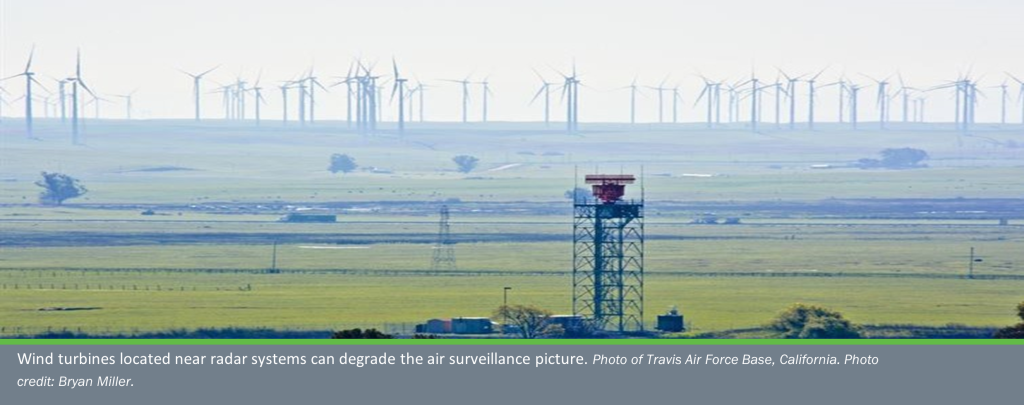
The wind turbine radar interference problem refers to the potential disruption of radar systems caused by the presence of wind turbines. Radar systems detect and track objects in the air, such as aircraft, weather patterns, or other potential threats. However, the rotating blades of wind turbines can create radar reflections and shadows, leading to false detections and reduced radar coverage. If not mitigated, such wind development could cause clutter and interference for radar systems involved in air traffic control, weather forecasting, homeland security, and national defense missions

Wind Turbine Radar Interference Mitigation (WTRIM) Working Group
To address this issue, the Wind Turbine Radar Interference Mitigation (WTRIM) Working Group was established by the 2014 Memorandum of Understanding (MOU) and an updated Memorandum of Agreement (MOA) in 2023 signed by the U.S. Department of Energy (DOE), the Department of Defense (DOD), the Department of Transportation’s (DOT) Federal Aviation Administration (FAA), the Department of Commerce’s (DOC) National Oceanic and Atmospheric Administration (NOAA), the Department of Interior’s (DOI) Bureau of Ocean Energy Management (BOEM), and the Department of Homeland Security (DHS) with the vision “to fully address wind turbine radar interference as an impact to critical radar missions, ensure the long-term resilience of radar operations in the presence of wind turbines, and remove radar interference as an impediment to future wind energy development.”
In 2023, DOE, with support from Sandia National Laboratories, released a Federal Interagency Wind Turbine Radar Interference Mitigation Strategy that details strategic activities and research themes.
Wind Turbine Radar Interference Mitigation Federal Strategic Themes
- Improving the capacity of government and industry to evaluate the impacts of existing and planned wind energy installations on radar systems.
- Developing and facilitating the deployment of hardware and software mitigation measures to increase the resilience of existing radar systems to wind turbines.
- Encouraging the development of next-generation radar systems that are resistant to wind turbine interference.
Useful Resources
- WTRIM Working Group Annual Progress Update for 2025
- WTRIM Working Group Annual Progress Update for 2024
- Update on the Efforts of the Wind Turbine Radar Interference Mitigation Working Group- Report to Congress, 2024
- WTRIM Working Group Annual Progress Update for 2023
- Offshore Wind Turbine Radar Interference Mitigation Webinar Presentations, 2020
Improving Capacity to Evaluate Impacts
Mitigating the interference that wind turbines have on radar systems begins with modeling proposed wind turbines and simulating the impact they may have on radar systems. Collaboration within the WTRIM Working Group has led to the development of tools available to the public to better understand the potential wind turbine siting challenges as they relate to radar systems.
Useful Resources
- U.S. Wind Turbine Database
- Wind Turbine Radar Interference Mitigation Modeling & Simulation Tools Catalog
Developing and Deploying Mitigation Measures
The WTRIM Working Group has led efforts to reduce risk for promising off-the-shelf solutions, particularly infill radar systems.
Supported by directives from Congress in 2011, a variety of candidate infill radars were rigorously tested under the Interagency Field Test & Evaluation (IFT&E) campaign to investigate and address the concerns of growing interference of wind turbines on our nation’s air surveillance radars. The program had three goals: 1) characterize the impact of wind turbines on existing Program-of-Record (POR) air surveillance radars; 2) assess near-term mitigation capabilities proposed by industry; and 3) collect data and increase technical understanding of interference issues to advance development of long-term mitigation strategies.
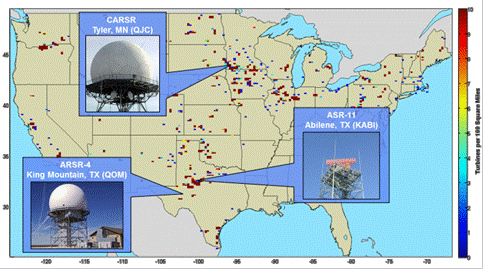
IFT&E test locations and tested POR systems.
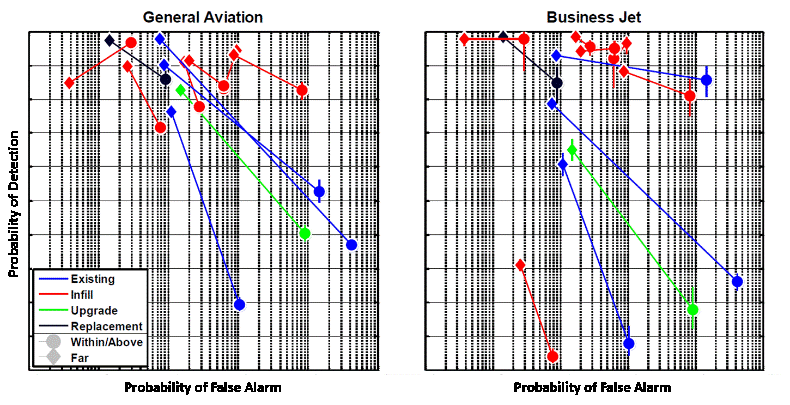
Tested POR systems and mitigations Probability of Detection and False Alarm for general aviation and business jets.
The IFT&E campaign found that in the regions directly above and very near the wind turbines within line-of-sight, all of the POR radars demonstrated a significant drop in ability to detect aircraft and also produced more false detection reports. Several of the mitigation technologies tested show great promise. However, most systems were still not fully mature at the time of testing and require additional testing and/or integration issues to be addressed.
Read the Interagency Field Test & Evaluation Public Report.
Related Projects
Sandia National Laboratories has leveraged their expertise in blade design to investigate techniques to incorporate Radar Absorbing Material (RAM) into the blade fabrication process in order to reduce the electromagnetic reflectivity of wind turbine blades, thereby making the air surveillance picture less cluttered.
Traditional blade designs typically consist of fiberglass laminate and balsa wood, materials chosen for their lightweight and structural properties. However, advancements in blade manufacturing have introduced carbon fiber laminates, which offer superior mechanical properties, such as higher stiffness-to-weight ratios. These materials are increasingly being adopted in wind turbine blade designs to improve performance and durability.
While these advancements benefit structural integrity, they introduce new challenges in electromagnetic modeling. Wind turbine blades are known to negatively affect surveillance radar performance due to their radar cross-section (RCS) characteristics. The introduction of carbon fiber materials adds complexity to this issue, as their electromagnetic properties differ significantly from traditional materials. Sandia National Laboratories is currently investigating the impacts carbon fiber materials have on the radar cross-section of wind turbine blades.
The WTRIM Working Group supported a Pilot Mitigation Project at the Travis Air Force Base (AFB). The FAA STARS Infill Radar Integration Project was aimed at developing an Infill Radar Interface Control Document, validating safety standards, and analyzing system performance within and around wind plants.
The goals of the Pilot Mitigation Project were to manage the risk to stakeholders while:
- Maintaining the current quality of the air picture.
- Reducing the time required to implement mitigation solutions.
- Minimizing the cost of delivering effective air surveillance services to government users.
- Meeting renewable energy goals.
Read the Public Report.
Encouraging the Next-Generation of Radar Systems
Many of the radar systems currently impacted by wind turbine interference are likely to be upgraded significantly or replaced by next-generation radars over the next few decades. Resilience to wind turbine interference should be a key design requirement for these next-generation radar systems.
A key role of the WTRIM Working Group is to ensure that next-generation systems include provisions for wind turbine requirements from the early stages of the development and acquisition process.
Useful Resources
Helpful Links
- Department of Energy’s WTRIM Page
- Department of War’s Military Aviation and Installation Assurance Siting Clearinghouse
- FAA’s Obstruction Evaluation / Airport Airspace Analysis (OE/AAA)
- NOAA’S Radar Operations Center
- NOAA’s Integrated Ocean Observing System
- BOEM Renewable Energy
Contact
Ben Karlson
bkarlso@sandia.gov