
Sandia National Laboratories is proud to announce the successful assembly of the U.S. Department of Energy’s (DOE’s) instrumented open-source tidal energy converter (OSTEC) reference turbine system by project partner the Atlantic Marine Energy Center (AMEC) at the University of New Hampshire (UNH). The turbine is currently at the UNH Research Pier to complete sensor and instrumentation checks prior to installation on the Turbine Deployment Platform at the AMEC-UNH tidal energy site in the Piscataqua River in Portsmouth, New Hampshire.
This multi-lab collaborative initiative has been led by Sandia alongside UNH as the primary research partner. The project also received significant contributions from the National Laboratory of the Rockies (NLR), which designed the data acquisition system known as Modular Ocean Data Acquisition (MODAQ), and the Pacific Northwest National Laboratory (PNNL), which collaborated on the turbine conceptual design and specified the power take-off (PTO), grid interconnection, and control system.
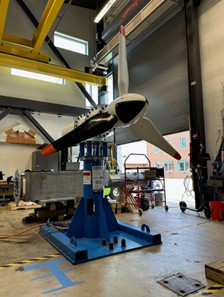
As a fully instrumented tidal energy test bed the OSTEC turbine system is poised to become a key enabler of significant research and development for U.S. tidal energy over the next 10 to 15 years. With over 50 sensors, this test bed is designed to collect over 1,000 different measurement data streams: archiving a terabyte of data every hour of testing. Planned studies include investigating the effects of turbulence on turbine load response, validating turbine design and analysis modeling tools, and testing turbine components and materials, e.g., blades, structural health monitoring sensors, and eco-friendly lubricants in gearboxes.
In addition to the design work, Sandia conducted static blade testing of the smart fiber optic sensor blades to validate predicted design loads, verify fiber optic sensors, and develop linear regression models for estimating blade loads from strain measurements. This rigorous testing also served to validate Sandia’s finite element analysis (FEA) model of the test blade that will enable digital twinning (creation of a virtual real time counterpart for simulation and analysis) and extension of field test measurements via hydro-elastic modeling of the OSTEC rotor (modeling of the complex fluid structure interaction and dynamic structural response of the rotor).
The University of New Hampshire and AMEC played a crucial role in the project, leading the design and fabrication of the power take-off (drive train transferring mechanical power from rotor to the motor-generator), nacelle (power-take-off housing aft of the rotor), and tower and yaw assembly, as well as upgrades to the test platform. They were responsible for all assembly, component and instrumentation integration.
NLR’s contributions included the incorporation of the MODAQ system, which will enable data collection and analysis capabilities for the project. Meanwhile, PNNL focused on the design of the PTO, selecting commercial off-the-shelf (COTS) gearboxes, generators, and power electronics, and conducted an analysis to inform the turbine’s water-cooling system.
As the OSTEC turbine system prepares for deployment, Sandia remains committed to advancing the field of marine energy through innovative research and collaboration. This project exemplifies the potential of tidal energy and sets the stage for future collaborative research and development using this open-source test bed for years to come.
This work was funded by DOE’s Hydropower and Hydrokinetic Office. For more information about Sandia’s work in marine energy and the OSTEC project, please visit Sandia’s Hydrodynamic Energy Systems page.
July 14, 2026