

The Sociotechnical Systems Group understands successful systems rely on analyzing and designing for the interplay between people, organizations, regulations, and technology. Our mission is to optimize both the social and technical aspects of systems to ensure they work effectively in their intended environments.

“Enhancing collaboration between people and technology”
Key Components of Our Approach
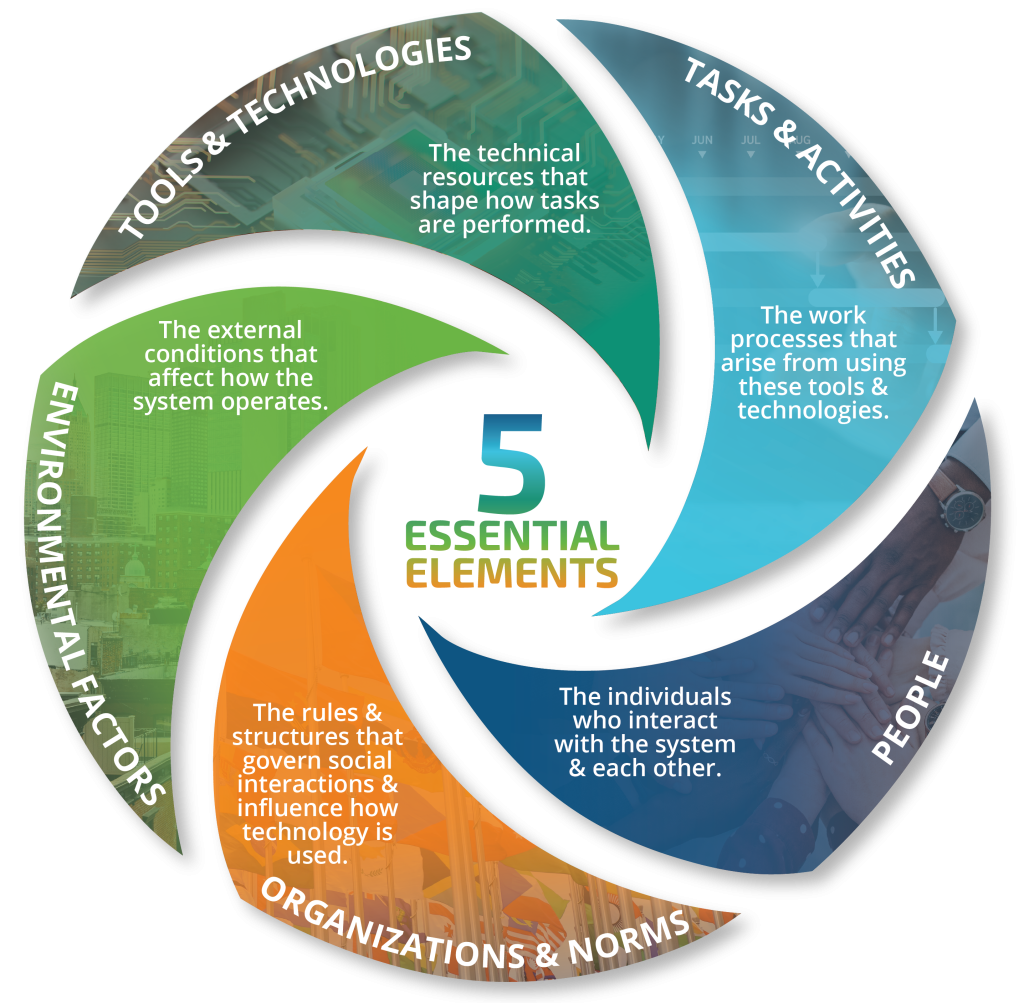
Our work is grounded in a balanced understanding of five essential elements:
How We Can Help
Our expertise can be applied in various ways to support your organization:

Strategic Planning & Decision Support
We help identify key components of your systems and their interactions to guide implementation decisions.

Trend & Media Analysis
Using artificial intelligence and other tools and methods, we analyze social trends, discourse, stakeholder perceptions, and public sentiment at scale and create insightful models
that inform your strategies.

Stakeholder Analysis & Engagement
We identify potential customers and their needs to ensure your solutions align with market demands.

Use-Case Development
We capture the expectations and requirements necessary for successful technology deployment.

Risk Management & Safety
We identify gaps in knowledge and systems to help mitigate risks.

Techno-Economic Analysis
We evaluate the interplay between technology and economics to provide actionable insights to support decision-making.
Areas of Focus and Expertise

“We work in areas critical to abundant energy production, assurance, and security.”
Sandia also leads in sociotechnical site characterization, which involves selecting and establishing locations for nuclear waste disposal facilities by integrating both social and technical considerations. Sandia offers an integrated suite of capabilities including economic analysis, mapping of community social structures and organizations, compiling contemporary and historic location case studies, and stakeholder engagement to gather perspectives, identifying information gaps, and understand interests and concerns. Additionally, Sandia leverages data and technical expertise to inform workforce transition, planning and development initiatives. This approach recognizes that the challenge of safely managing nuclear waste is not just a technical or engineering problem but also deeply intertwined with social, political, cultural, and community factors.
Shaping Sandia’s Holistic Advanced Reactor Capabilities Center (SHARCC). SHARCC represents the core capabilities and nuclear energy/facility related work of three Sandia programs: Nuclear Energy Fuel Cycle, Nuclear Energy Safety Technologies, and Global Engineered Security Systems. Together, these three programs support a broad range of sponsors and their involvement in SHARCC allows for coordinated leadership of a body of work to more effectively meet national needs.
Identifying and engaging the market for emerging decision support technology for microgrid hardening. We are collaborating with technology developers and grid experts to create a microgrid resilience planning tool that helps decision-makers harden microgrids against environmental hazards by identifying and prioritizing risk mitigation alternatives. Our efforts involve analyzing stakeholder networks across various geographies and hazard scenarios to understand their information needs and decision-making processes, ensuring the tool effectively addresses the unique challenges stakeholders encounter in different contexts.
Implementing collaboration-based siting, a flexible and adaptive method to improve public understanding and process design for critical infrastructure, such as spent nuclear fuel storage and power plants. We assist the Department of Energy’s (DOE) Office of Collaboration Based Siting in developing a robust metrics program by collaborating with leadership to define and operationalize key programmatic metrics. Our efforts include evaluating existing information needs, identifying gaps, and proposing new data reporting methods, ultimately collecting and reporting metrics from five national laboratories and the DOE to enhance strategic planning and data-driven decision making.
As partners in the Consortium Advancing Technology for Assessment of Lost Oil and Gas Wells (CATALOG), we are identifying best practices for developing and deploying technologies that can it easier and more cost-effective for stakeholders to collect environmental monitoring data. Our work involves analyzing existing technologies and deployment strategies to generate actionable recommendations that strengthen CATALOG’s efforts and ensure that our solutions effectively address stakeholder needs and challenges.
Optimize organizational efficiency, innovation, and decision-making by leveraging the collective knowledge and expertise of the workforce. Our team utilizes workshops, deep dives, critical knowledge mapping, and taxonomy and repository design to capture, retain, and transfer critical knowledge across DOE-NE. Assisting expert teams in identifying critical knowledge gaps associated with retaining and developing workforce in R&D in deep geologic repository science and engineering.
Designing and implementing tools, data resources, and analytical methods to facilitate gap analysis and strategic planning. Our approach integrates streamlined workflows that enable more effective identification of long term community-level workforce needs and support informed decision-making.
Benefits of Working with Us
By partnering with the Sociotechnical Systems Group, you can expect to:

Design systems that consider social factors from the outset.

Enhance the validation process for systems and products.

Create efficient and effective research and development project lifecycles

Improve human interactions and planning to facilitate technology readiness and adoption.
Publications
- Decision Support for Microgrid Hardening: State & Regional Insights on Hazards, Information, and Microgrid Systems
- Sociotechnical Systems Analysis and Design
- Bastian, L., Drakopulos, L., Mendez, C.M., & Webb, E.K. (2025, November 18-20). Communicating the technical reliability of geological repositories: Engaging a wide range of stakeholders. (SAND2025-13810PE). [Presentation]. Japan Nuclear Waste Management Organization (NUMO) Technical Advisory Committee Meeting, Tokyo, Japan.
- Bastian, L., Drakopulos, L., Price L., Taconi, A., Mendoza, H., Clavier, K., Dharsandia, J., Garcia, M., Orr, A., & Mendez, C. (2026). Response to request for information: Development of a commercially viable system-centric small modular reactor concept for deployment in the marine transportation system. (SAND2026-24625O). [Response to Request for Information; Comment ID MARAD-2026-0729-0042]. Regulations.gov. https://www.regulations.gov/comment/MARAD-2026-0729-0042
- Drakopulos, L., Gano, G., Meacham, J., Mendez, C., Sweitzer, D., Bastian., L., & Wilson, M. (2024, November 7-8). Sociotechnical systems from theory to practice: A national laboratories perspective. (SAND2024-15132C). [Conference presentation].Phoenix Project: From Kikuchi to Fastest Path, an International Symposium on Sociotechnical Research on Nuclear Technology,Ann Arbor, MI, United States.
- Drakopulos, L., Mendez, C., Gano, G., & Bevard, B. (2024). Sociotechnical systems analysis to identify best practices for facility siting. Transactions of the American Nuclear Society, 130(1), 72-75. https://doi.org/10.13182/T130-44127
- Louie, M.S., Gunda, T., Drakopulos, L.A., Rosewater, D.M., Young, M., Mousavinezhad, A., & Dashtian, H. (2024, December 9-13). A framework for holistic characterization of health impacts associated with energy transitions. (SAND2024-15996D). [Conference presentation]. AGU24, Washington, D.C., United States. https://doi.org/10.2172/3005467
- McJunkin, T., Poudel, B., Epiney, A., Kang, N., Myers, K., Abou-Jaoude, A., Darbali-Zamora, R., Mammoli, A., Ropp, M.E., Armijo, K., Drakopulos, L., Gano, G., Bastian, L., Wilson. M., Price, L., Mann, W.N., Hovsapian, R., & Grappone, J.M. (2026). Microgrids R&D strategic plan: Topic 7 – small nuclear reactors in future microgrids. U.S. Department of Energy.
https://www.energy.gov/documents/microgrid-rd-strategic-plan-topic-7-small-nuclear-reactors-future-microgrids - Mendez Cruz, C., Wilson, M., & Brady, P. (2021). Sociotechnical systems design for consent-based siting of nuclear waste facilities (SAND2021-8142C). Sandia National Laboratories (SNL-NM). https://www.osti.gov/servlets/purl/1882291
- Sweitzer, M. D., & Gunda, T. (2024). Spatiotemporal analyses of news media coverage on “nuclear waste”: A natural language processing approach. Nuclear Technology, 210(9), 1706–1721. https://doi.org/10.1080/00295450.2023.2229566
- Sweitzer, M.D., Sanchez, D.N., Rogers, A., Gunda, T., Drakopulos, L., & LaForce, T. (2024). Thematic shifts in discussion and questions about consent-based siting. Transactions of the American Nuclear Society, 130(1), 64-67. https://doi.org/10.13182/T130-44351

Let us help you bring technology and people together for better and more efficient enterprises. Contact us today to learn how we can support your organization.