
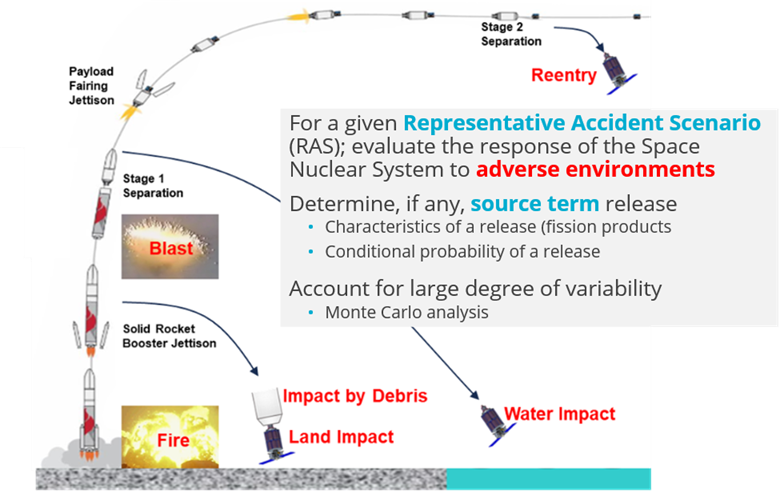
Accident environments can occur during any phase of the launch. Sandia’s ability to identify and mitigate mission risk across the full mission timeline is critical to launch success and helps mission teams focus mitigation efforts on the highest-risk contributors.
For the analysis, missions are typically divided into time-based phases that depend on the mission profile. These phases can include prelaunch, early launch, late launch, suborbital reentry, orbital reentry, operations, and long-term reentry. Within each phase, credible accident environments are defined and then grouped into Representative Accident Scenarios (RASs). Results from each RAS are weighted by their relative probabilities and combined to produce phase-level and overall mission risk estimates.
Mission Phases
Sandia defines risks in terms of launch sequencing and mission phases. One example is the phased framework used for the Mars 2020 mission, which divided the mission into Phases 0–5:
- Phase 0 – Prelaunch, T < t1, from installation of the system through just prior to engine start at t1.
- Phase 1 – Early Launch, t1 ≤ T < tx, engine start through the point when there is no potential for land impact in the launch area, tx.
- Phase 2 – Late Launch, tx ≤ T, end of Phase 1 until the launch vehicle reaches 30,480 m (100,000 ft), above which reentry heating could occur.
- Phase 3 – Suborbital Reentry, end of Phase 2 through just prior to achieving orbit.
- Phase 4 – Orbital Reentry, end of Phase 3 through spacecraft separation.
- Phase 5 – Long-Term Reentry, end of Phase 4 until there is no longer any credible chance of Earth reentry.
ROCQET Launch Safety Code Suite
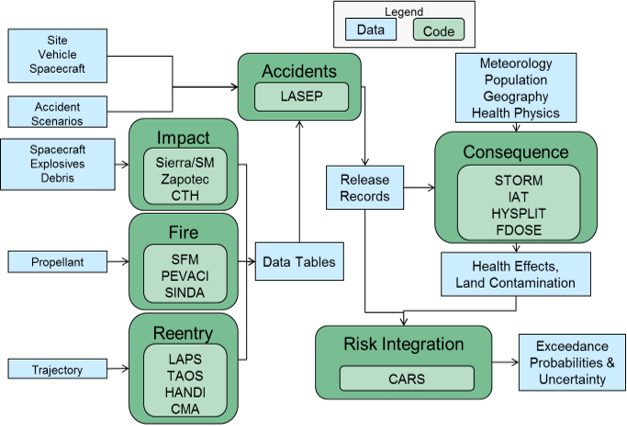
Using the ROCQET launch safety code suite, Sandia can model a wide range of accident phenomena, including blast and impact events, criticality, launch-vehicle propellant fires, atmospheric reentry, accident sequence progression, atmospheric transport and food-chain pathways, and resulting health effects. ROCQET comprises hundreds of thousands of lines of code and supporting scripts and is developed and maintained under a rigorous quality assurance program. The accompanying graphic depicts the flow of information through the toolset, from initial inputs on the left to integrated consequence and risk results at the lower right.
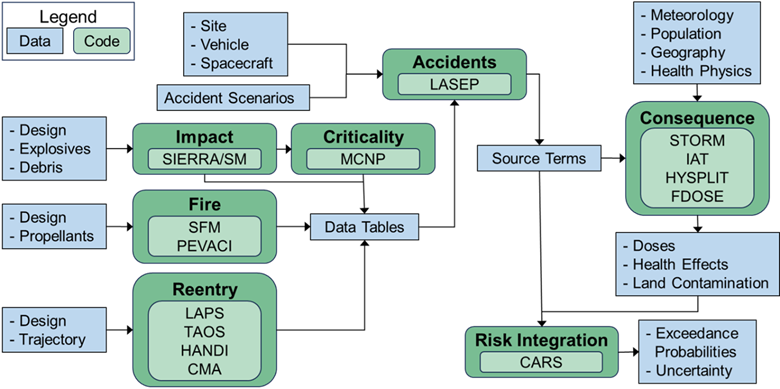
Launch Accident Sequence Evaluation Program (LASEP)
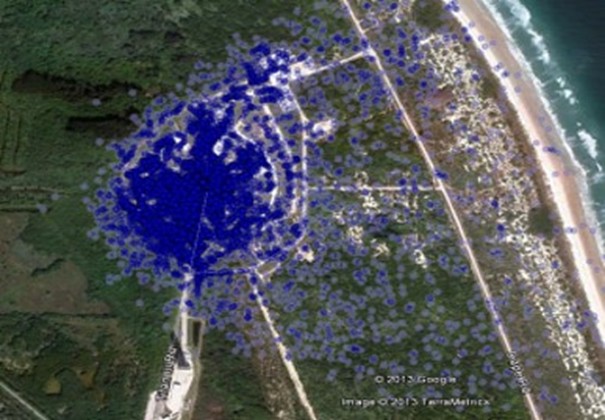
LASEP models numerous potential scenarios, randomly choosing time of failure, explosion characteristics, release location and amount determined mechanistically. Typically, millions of different trials are run. Each trial provides a separate determination of the probability distribution for possible release amounts and size distribution of nuclear material. Distribution functions for material release are sampled and used as the source term for thousands of consequence simulations, where weather conditions and other atmospheric transport and consequence parameters are varied. A probability distribution for adverse consequences are the resulting outcomes.
Click here to return to main Space Nuclear Systems Launch Safety landing page.