
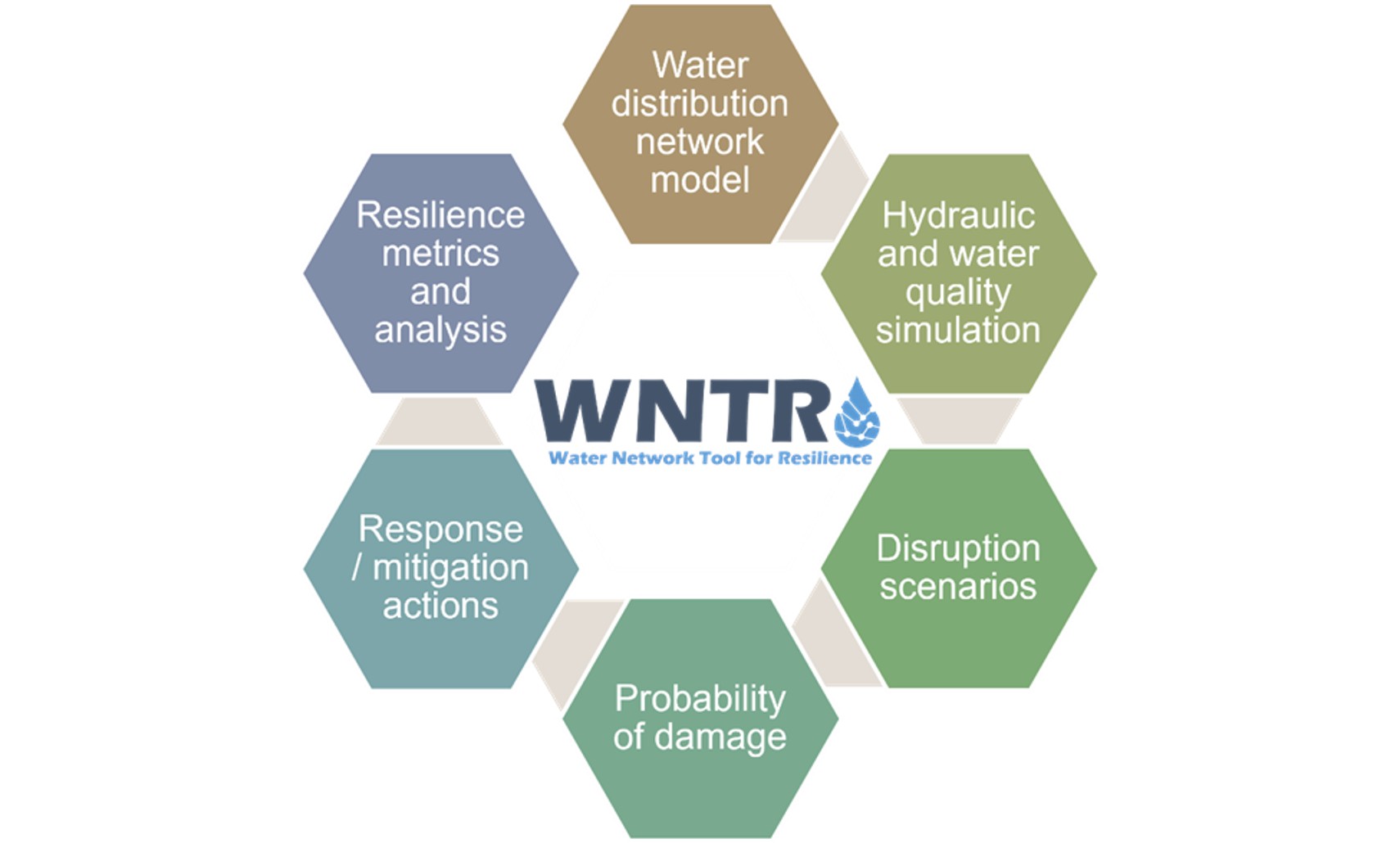
The Water Network Tool for Resilience (WNTR) (Klise et al., 2023) is an open-source Python package designed to analyze water distribution system resilience, developed at Sandia in partnership with the U.S. Environmental Protection Agency. The software includes capabilities to generate water distribution system models and evaluate resilience considering disaster and recovery scenarios. WNTR can be used to estimate infrastructure damage, evaluate preparedness strategies, prioritize response actions, and identify worse case scenarios and best practices for maintenance and operations. The software is hosted on the USEPA’s GitHub site, which includes instructions to download the software.
Sandia and the EPA use WNTR to work directly with water utilities, providing resilience analysis focused on important regional challenges. Results have been used to prioritize upgrades and understand potential water service disruptions to critical facilities. Example case studies are summarized below:
- Power outage resilience analysis for the U.S. Virgin Islands Water and Power Authority helped prioritize upgrades after the 2017 Hurricane season (Irma and Maria) (Klise et al., 2022)
- Pipe criticality and source water resilience analysis for the City of Poughkeepsie, NY, helped identify critical hydraulic pathways in the system and test mitigation strategies (Chu-Ketterer et al., 2022)
- Landslide resilience analysis for a water system in Pennsylvania helped identify how pipe damage from landslides impact water pressure at critical facilities (Hogge et al., 2024)
- Geospatial analysis and machine learning, using water utility data from Puerto Rico, helped build water distribution system models from sparse datasets (Bonney et al., 2024, Poff et al., 2025)
WNTR also has an active external user community, which includes water utilities, universities, and government agencies. WNTR has been used to prioritize capital program spending and train next generation engineers in hydraulic modeling.
A subset of the capabilities in WNTR can be accessed online through the interactive WNTR-Dash website. The dashboard is tailored to address the needs of U.S. military installations, with a focus on mission critical water service and response action plans.
Resources
Fact Sheets
Success Stories
“Water Network Tool for Resilience Helps Prepare Drinking Water Utilities for Natural Disasters,” EPA 2021
“EPA Researchers Help Prepare Drinking Water Utilities for Natural Disasters,” EPA 2019
Featured Publications
K.L. Bonney, K.A. Klise, J.W. Poff, S. Rivera, I. Searles, and M. Chester. 2024. “Data-informed synthetic networks of water distribution systems for resilience analysis in Puerto Rico.” Water 16(23), 3356. https://doi.org/10.3390/w16233356
L-J. Chu-Ketterer, R. Murray, P. Hassett, J. Kogan, K. Klise, and T. Haxton. 2022. “Performance and resilience analysis of a New York drinking water system to localized and system-wide emergencies.” Journal of Water Resources Planning and Management 149(1). https://doi.org/10.1061/jwrmd5.wreng-5631
J. Hogge, K. Klise, D. Hart, and T. Haxton. 2024. “Geospatial capabilities to couple hazard and social vulnerability data in water distribution criticality analysis.” Journal of Water Resources Planning and Management 151(2). https://doi.org/10.1061/jwrmd5.wreng-6582
K. Klise, R. Moglen, J. Hogge, D. Eisenberg, and T. Haxton. 2022. “Resilience analysis of potable water service after power outages in the U.S. Virgin Islands.” Journal of Water Resources Planning and Management 148(12). https://doi.org/10.1061/(asce)wr.1943-5452.0001607
K.A. Klise, D.B. Hart, M. Bynum, J. Hogge, R. Murray, J. Burkhardt, and T. Haxton. 2023. Water Network Tool for Resilience (WNTR) User Manual: Version 1.0. U.S. Environmental Protection Agency Technical Report, EPA/600/R-23/098.
J.W. Poff, K. Bonney, and M. Chester. 2025. “Predicting large-scale systematic missing pipe attributes in water distribution networks.” Water Resources Research 61(12). https://doi.org/10.1029/2025WR040281
Related Work
Chama is an open source Python package that uses mixed integer linear programming to determine the best location and technology for your sensor network. Optimization can help maximize monitoring effectiveness and reduce the overall cost of sensor networks. The methods in Chama can be applied to many applications, including environmental monitoring, process safety, and asset protection.
Pecos is an open source Python package designed to monitor performance of time series data, subject to a series of quality control tests. The software includes methods to run quality control tests defined by the user and generate reports which include performance metrics, test results, and graphics. The software has been used to monitor energy and water systems.
Contact
Katherine Klise, kaklise@sandia.gov
Kirk Bonney, klbonne@sandia.gov