
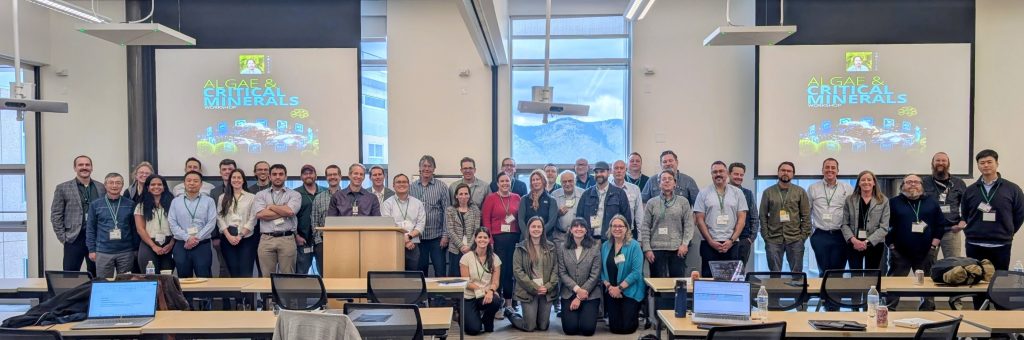
Sandia National Laboratories and the National Laboratory of the Rockies recently hosted the 2026 Algae and Critical Minerals Workshop. The event brought together 80 attendees from industry, academia, and the DOE National Laboratories to establish a strategic roadmap for research and development (R&D) priorities focused on algae technologies for critical mineral and materials (CMM) applications.
The primary goal of the workshop was to produce a feasibility report to guide public-private partnerships in advancing algae technologies for critical minerals. The workshop was designed to align efforts to accelerate innovation in resource recovery, particularly in mining, water treatment, and bioenergy production.
“The overarching goal was to identify beachhead opportunities for algae systems to treat aqueous effluents for economically increasing domestic supply of CMMs,” explained Sandia’s Ryan Davis.
Workshop breakout discussions centered on three key topical areas: algae cultivation systems, biomass processing, and the economics of scaling up these technologies. During these sessions, participants explored the unique advantages and technical challenges algae face in the critical minerals space and identified success metrics for integration with existing technologies. They also examined how to leverage current investments in algae processing to address market needs and neglected feedstocks, while considering barriers to integration with CMM extraction. Economic considerations and data-driven assessments were emphasized as essential to accelerating progress and enabling algae technologies to compete across various mineral markets.
“Whereas achieving sufficient concentrations of CMM in algae appears within reach, the compatibility of the bio-ore with commonly used beneficiation technologies still faces major risks for scale-up,” said Ryan.
This workshop and similar events are critical to create coordinated R&D efforts that could transform algae-based technologies into viable, competitive solutions for critical mineral recovery and resource management, fostering interdisciplinary partnerships to overcome technical and economic barriers. The workshop was supported by the U.S. Department of Energy’s Alternative Fuels and Feedstocks Office, formerly known as the Bioenergy Technologies Office.
July 8, 2026