
Factoring in Launch Weather Conditions
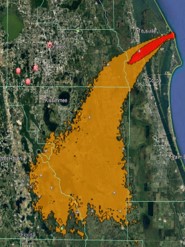
Meteorological conditions vary in space and time, which governs the transport and diffusion of the released material. These conditions include wind velocity components, relative humidity, atmospheric turbulence, and pressure. Local meteorology strongly affects both the potential rise of the particles from the fire environments and the transport of the particles to the surrounding areas. The transport of released material is determined by the STORM (Sandia-developed Transport Of Radioactive Materials) code. STORM calls the Initial Atmospheric Transport (IAT) code to determine the initial rise of the fireball and particles. STORM then uses the National Oceanic and Atmospheric Administration’s Hybrid Single Particle Lagrangian Integrated Trajectory (HYSPLIT) model to determine the subsequent transport and deposition.
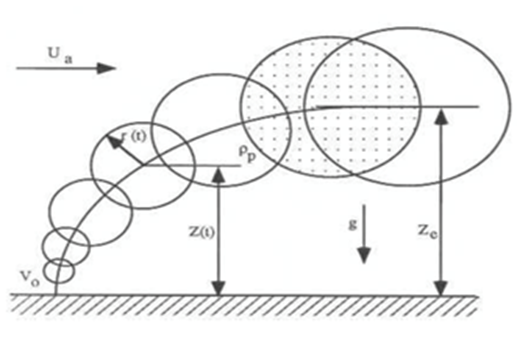


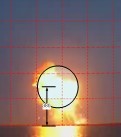
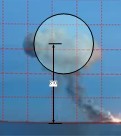
Meteorological effects modeled by HYSPLIT
STORM’s atmospheric dispersion modeling uses the HYSPLIT code and a Lagrangian particle-tracking approach. The model releases many computational particles (from thousands up to about one million) and tracks their transport and deposition as they move through the atmosphere. Each particle is advected by the mean wind field plus a randomly sampled turbulent fluctuation whose magnitude is determined by turbulence intensity contained in time-dependent, three-dimensional gridded meteorological input data.
The turbulent component is treated as time auto-correlated, which avoids unphysical, abrupt changes in particle velocity along a trajectory. Because turbulence is sampled stochastically, particles follow different paths, and dispersion emerges directly from the variability across trajectories rather than from empirical correlations (as in Gaussian puff/plume models). Each modeled “Lagrangian particle” represents a large population of real aerosol particles (e.g., a 1-gram release of 1-µm unit-density aerosols contains >1012 physical particles), so tens to hundreds of thousands of computational particles are used to represent the physical release.
Exposure Pathways
Consequences from mission launch, orbit and reentry accidents can lead to various human health and environmental implications. The Fortran Dose (FDOSE) code is used to model health effects from the plume. Pathways, such as the inhalation, resuspension, ingestion, cloudshine, and groundshine, are included when determining the consequences to the surrounding environment. Mitigation strategies can be used to lessen the impact on the population and the environment.
Following the transport of the released material, the radiological consequences are calculated in terms of 1) maximum individual dose; 2) collective dose; 3) health effects; and 4) land area contaminated at or above specified levels. Multiple exposure pathways are considered in these types of analysis. Some exposure pathways result from deposition onto the ground and include groundshine, ingestion, and additional inhalation from resuspension.
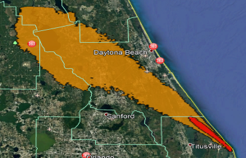
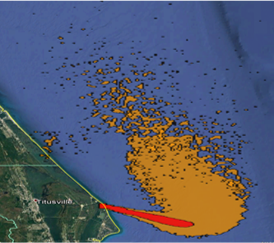
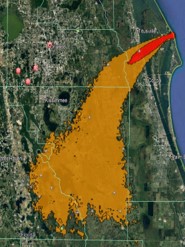
Meteorological effects modeled by HYSPLIT
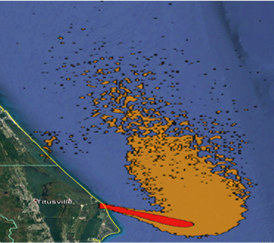
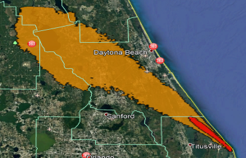
Exposure Pathways
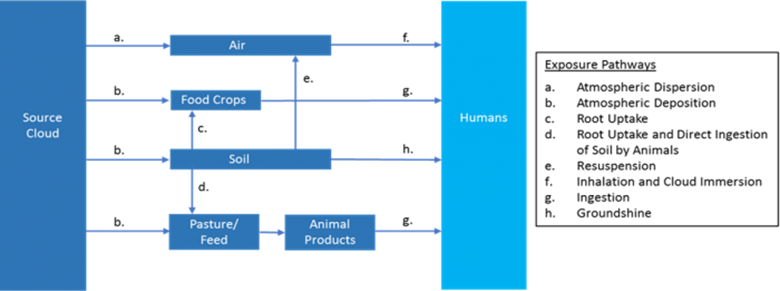
Launch, orbital, and reentry accidents can produce radioactive plumes with potential human-health and environmental consequences. Sandia uses the Fortran Dose (FDOSE) code to estimate health effects from these plumes by accounting for multiple exposure pathways, including inhalation, resuspension, ingestion, cloudshine, and groundshine. The results help inform mitigation strategies that can reduce impacts to both the population and the environment.
After atmospheric transport and deposition are modeled, radiological consequences are typically reported as (1) maximum individual dose, (2) collective dose, (3) estimated health effects, and (4) land area contaminated at or above specified levels. Pathways driven by ground deposition are explicitly considered, including external exposure from groundshine, ingestion through contaminated food or water, and additional inhalation due to resuspension of deposited material. The pathways are illustrated in the figure below.
Risk and Uncertainty
Both risk and uncertainty provide a comprehensive picture to cover the entire analysis process, including:
- Performance of stability and convergence analyses
- Update of unknown probability distributions using Bayesian Methods.
Click here to return to main Space Nuclear Systems Launch Safety landing page.