
Concentrating Solar Thermal Technologies
Developing and testing concentrating solar thermal technologies for over 40 years
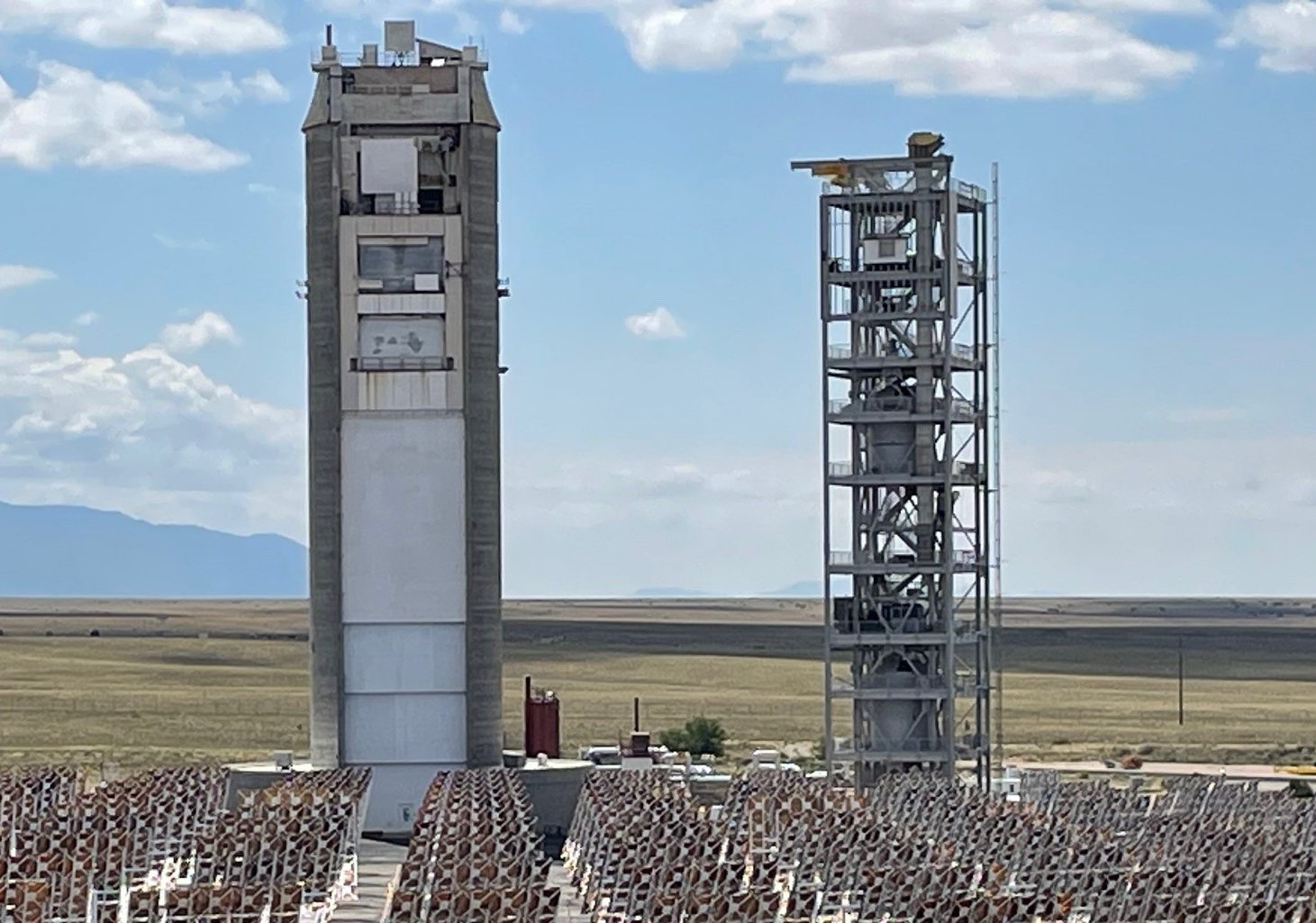
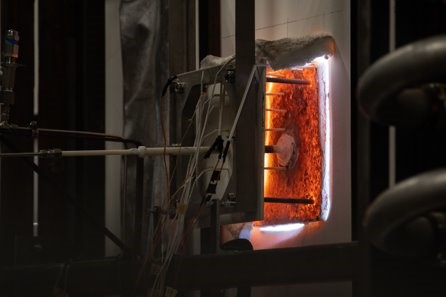
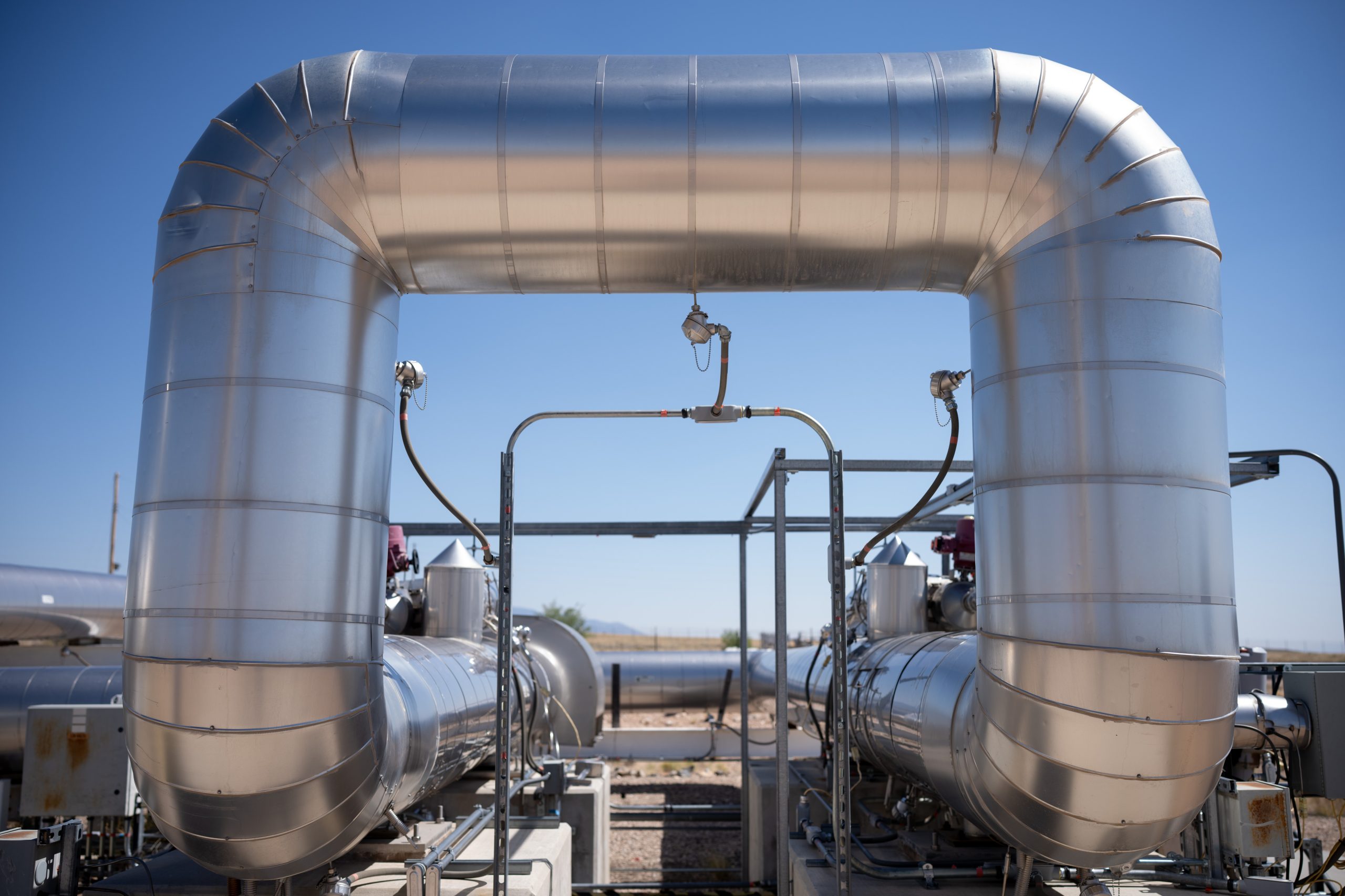
The National Solar Thermal Test Facility is the only test facility of its kind in the United States, providing a range of high flux and extreme temperature capabilities using concentrated sunlight to support the development of solar thermal energy technologies and the next generation of materials.
Research Focus Areas
Tools
OpenCSP
OpenCSP is an open-source platform including source code, applications, and data to enable collaborative development for the CSP community worldwide, supporting industry, research, and education. Learn more about OpenCSP, a community code development and data sharing environment.
Contact: Randy Brost, rcbrost@sandia.gov
Computer Aided Design
The CSP team uses a suite of computer aided design software such as Ansys, Solidworks, and Labview.
Solar Glare Analysis Tool (SGHAT)
SGHAT identifies potential ocular impact from observed glare. Its configurations can be quickly modified, e.g., tilt, orientation, shape and location to identify a design that mitigates glare while maximizing energy production. It is available for internal Sandia use only. Public use of licensed SGHAT applications are available at ForgeSolar glare analysis tools.
SGHAT meets Federal Aviation Administration glare analysis requirements (78 FR 63276).
Visit the ForgeSolar website to learn more about SGHAT’s evolution.
Empirical Glare Analysis Tool
This tool allows the user to empirically quantify glint and glare from reflected light and assess the potential impact, e.g,. temporary after-image or retinal burn. No expensive equipment is required. Users simply upload photos of the glare and the sun.
Contact: Aaron Spieles, ajspiel@sandia.gov
Analytical Glare Estimation Tool
Users can analytically predict the potential impact, e.g., temporary after-image or retinal burn of observed glare.
Contact: Aaron Spieles, ajspiel@sandia.gov
Phlux Mapping Analysis Tool
This tool allows users to empirically determine the irradiance distribution on a central receiver. No flux gauge is needed. Simply upload photos, fill in the details and the tool does the rest.
Contact: Aaron Spieles, ajspiel@sandia.gov
Infrared Signature Analysis Tool (IRSAT)
The Infrared Signature Analysis Tool was developed to enable users to evaluate the spectral irradiance from alternative systems at user-prescribed source temperatures and distances between the observer and source. The spectral irradiance profiles can then be analyzed for compatibility with optical sensors. In addition, computational fluid dynamics models have been developed to characterize vapor plumes generated from geothermal power plants.
Contact: Aaron Spieles, ajspiel@sandia.gov
Sandia Fringe Optical Analysis Slope Tool (SOFAST 2.0)
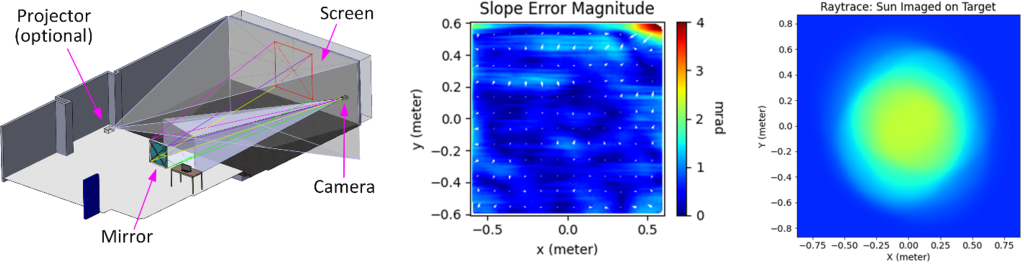
SOFAST 2.0 is a system for measuring high-resolution maps of mirror slope. It produces a variety of analytic output products; slope error magnitude and built-in ray-tracing analysis are shown below. It is flexible and can be applied to a wide variety of physical layouts.
Location
- OpenCSP_Code: opencsp/opencsp/app/sofast
https://opencsp.readthedocs.io/en/latest/library_reference/app/sofast/index.html - OpenCSP_Code: opencsp/example/sofast_calibration
https://opencsp.readthedocs.io/en/latest/example/sofast_calibration/index.html - OpenCSP_Code: opencsp/example/sofast_fixed
https://opencsp.readthedocs.io/en/latest/example/sofast_fixed/index.html - OpenCSP_Code: opencsp/example/sofast_fringe
https://opencsp.readthedocs.io/en/latest/example/sofast_fringe/index.html
Documentation
- B. J. Smith, R. C. Brost, and B. G. Bean. SOFAST 2.0 User Guide and Technical Description, Document Version 1.0. Sandia National Laboratories Report SAND2024-10936, August 2024.
- B. J. Smith, R. C. Brost, and B. G. Bean. OpenCSP Deflectometry Technical Description, Document Version 1.0. Sandia National Laboratories Report SAND2024-10934, August 2024.
- B. J. Smith, R. C. Brost, and B. G. Bean. Scene Reconstruction User Guide, Document Version 1.0. Sandia National Laboratories Report SAND2024-10625, August 2024.
- B. J. Smith, R. C. Brost, and B. G. Bean. OpenCSP Camera Calibration, Document Version 1.0. Sandia National Laboratories Report SAND2024-10619, August 2024.
- F. M. Brimigion and R. C. Brost. SOFAST CAD Layout Tool Overview and User Guide, Document Version 1.0. Sandia National Laboratories Report SAND2024-10380, August 2024.
Contact: Randy Brost, rcbrost@sandia.gov
System Advisor Mode (SAM)
Sandia National Laboratories and the National Renewable Energy Laboratory collaborated to include probabilistic analysis using the SAM system tool.
Visit the SAM website.
Computational Fluid Dynamics
ANSYS FLUID
Solid Works Flow Simulation (SWFS)
The CSP team uses the Solid Works Flow Simulation to design and simulate the flow process in their concentrating solar power systems.
Visit the Solid Works Flow Simulation website.
Finite Elements Analysis
ANSYS Mechanical
The CSP team uses the ANSYS Mechanical application to model and engineer mechanical components for concentrating solar power research.
Visit the ANSYS Mechanical website.
SolidWorks Simulation
The CSP team uses this simulation software to simulate and create mechanical components for concentrating solar power systems.
Visit the Solid Works Flow Simulation website.
SIERRA
The high performance computing platforms known as SIERRA is for internal use only by Sandia National Laboratories personnel due to cyber security restrictions. The CSP team uses SIERRA platforms for higher fidelity thermal and mechanical simulations of the receiver, heat exchanger and storage components of a concentrating solar power system. In the same suite as SIERRA, Matlab software is included to perform image processing and modeling.
Work with us
We partner with large and small businesses, universities, and government agencies. With multiple agreement types to select from, partners can access world-class science, engineering, experts, and infrastructure.
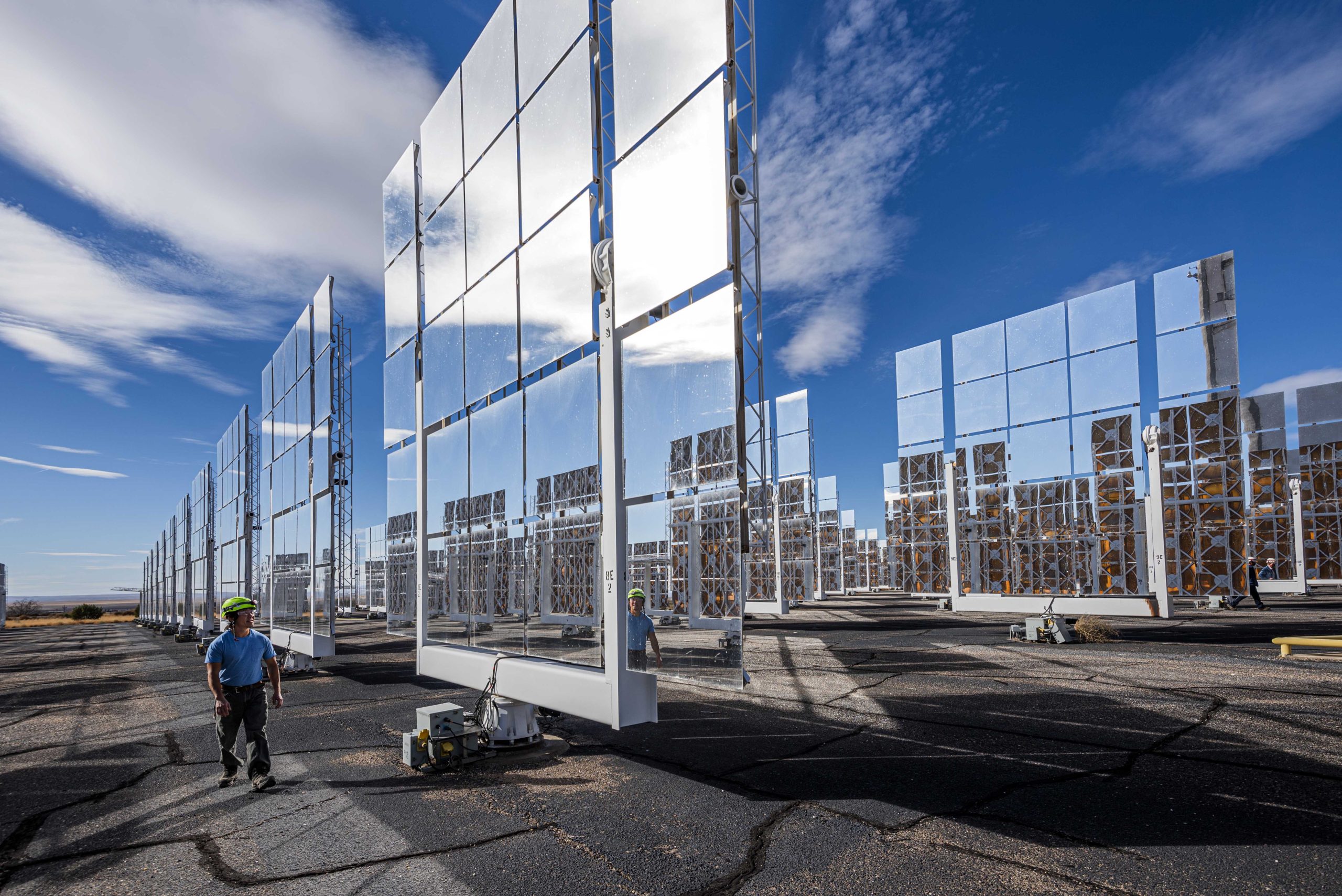
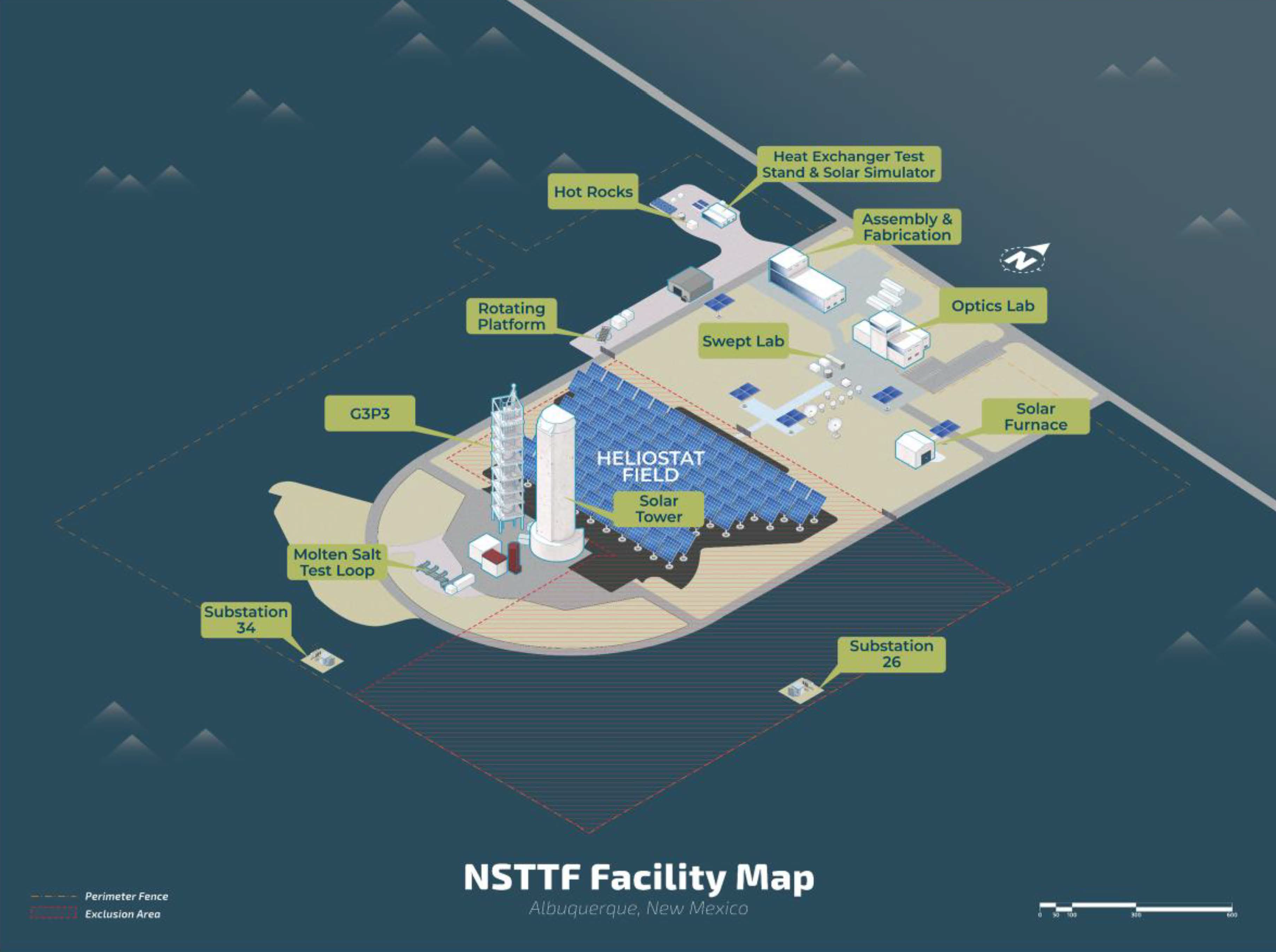
Beginning in the 1980s and continuing through today, Sandia has pioneered concentrating solar power technology and continues to research solar thermal technologies improvements. Sandia’s unique National Solar Thermal Test Facility includes a solar tower featuring 200+ heliostats, a solar furnace, a solar simulator, and many other test capabilities. Research conducted at the facility spans fundamental research through technology commercialization that can impact energy and security.
Resources
The National Solar Thermal Test Facility is operated by Sandia National Laboratories for the U.S. Department of Energy. The 10-acre research and development and testing facility located in Albuquerque, New Mexico, provides access to unique testing infrastructure which can achieve some of the highest and most controlled solar concentrations in the world. The NSTTF is home to Sandia’s Concentrating Solar Thermal group, which conducts cutting-edge research and development to make CST more efficient, more economical, and more broadly applicable to the nation’s electricity and thermal energy needs.
History
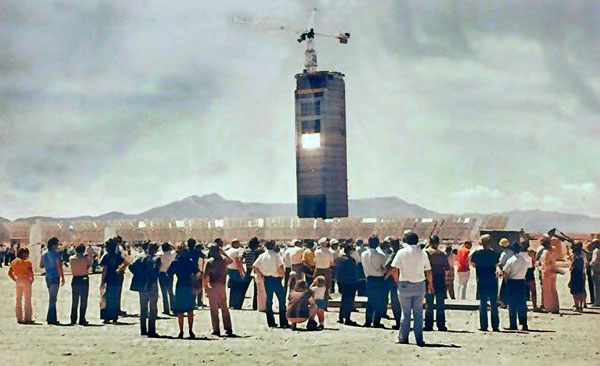
Construction on the NSTTF began in 1976, and the site was commissioned in 1978. Throughout its existence, the facility contributed to research in solar energy, space exploration, and defense capabilities. The NSTTF led the early development of the first pilot concentrating solar power tower plants: Solar One, a seven-megawatt pilot plant completed in the Mojave Desert in 1981, and Solar Two, an upgrade of the plant in 1995 to ten megawatts of production and three hours of thermal storage using molten salts. The NSTTF contributed to the progression of CST and CSP technologies, from early steam-based solar receivers to molten salt heat transfer and storage media, to next-generation solid particle technologies, which unlock higher efficiencies, lower costs, and longer-duration energy storage. The NSTTF also supported a range of CST technologies including parabolic troughs, dish concentrators, and heliostat field designs from the research and development stage to deployment at the commercial scale.
Today
Thermal Energy Storage
The National Solar Thermal Test Facility welcomed Scott Hume of the Electric Power Research Institute and Luke McLaughlin of Sandia National Laboratories for the Concentrating Solar Seminar Series session, “Thermal Energy Storage.”
Watch the seminar recording.
Overview and Opportunities for the Generation 3 Particle Pilot Plant
The National Solar Thermal Test Facility’s Concentrating Solar Seminar Series recently presented, “Overview and Opportunities for the Generation 3 Particle Pilot Plant,” an informative discussion regarding completion of the G3P3 tower.
Download the G3P3 presentation or watch the recorded CSP.
Thermal Energy Paradigms
Sandia National Laboratories’ Concentrating Solar Seminar Series featured Dr. Charles Forsberg, of the Massachusetts Institute of Technology (MIT), for his presentation, “Thermal Energy Storage Paradigms.”
Download Thermal Energy Storage Paradigms.
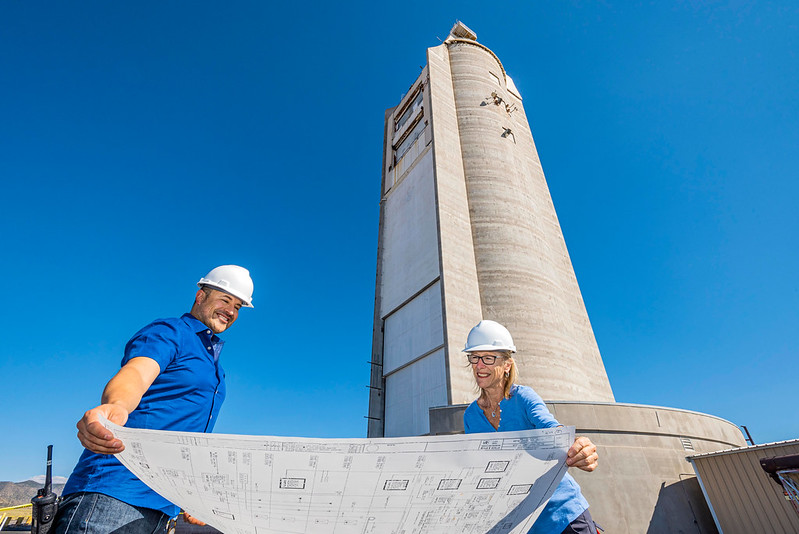
Sandia National Laboratories’ National Solar Thermal Test Facility and Sandia Technical Library developed the world’s first and only digital collection of Concentrating Solar Power related historical documents, dating back to the CSP program’s inception at Sandia in the 1970’s to the present.
This archive includes a significant number of paper-based documents spanning reports, engineering drawings and other media recently converted to digital format. It will provide CSP researchers a unique library of files to help make a larger historical body of CSP documents accessible to the Sandia and global CSP research and development communities.
For more information, contact the CSP Team.
Contact experts through the Earth, Energy, and Environmental Science directory.
Take a Virtual Tour of the National Solar Thermal Test Facility.
Contact
Margaret Gordon, Concentrating Solar Thermal Research and Development
megord@sandia.gov
Robert Keene, National Solar Thermal Test Facility
rskeene@sandia.gov