
The National Solar Thermal Test Facility focuses its efforts on researching and developing thermal energy storage systems for industrial heat processes.
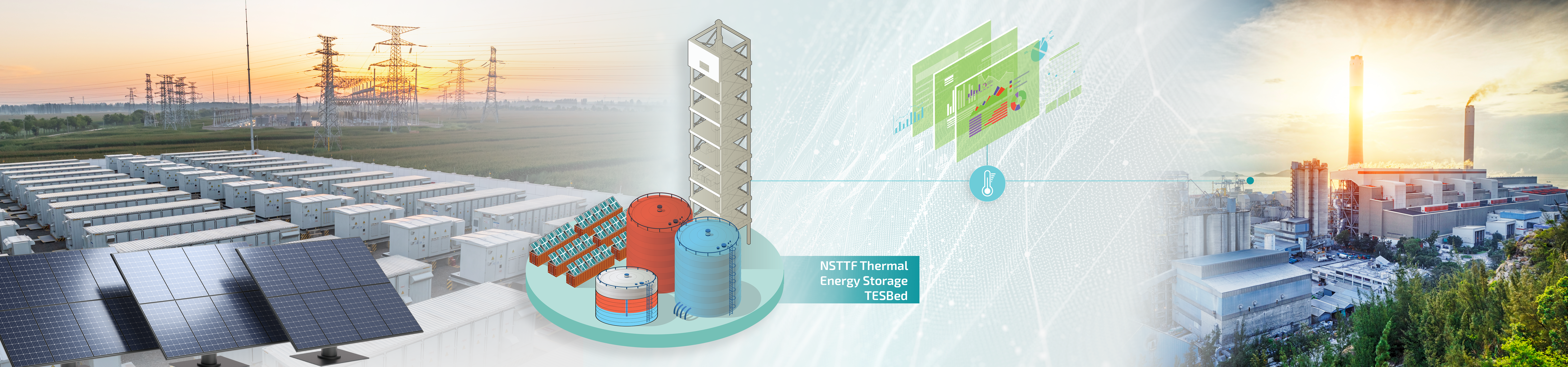
Thermal Energy Storage 2
Thermal energy storage has a number of benefits, including high-energy density, low costs, a readily available media storage, the ability to deliver heat and electricity, and the ability to be charged with heat and electricity. But challenges to TES deployment remain. Investors are hesitant due to limited build out, industry is risk averse to novel technologies, and TES benefits are not widely understood. With decades of experience in molten-salt development and solid media research and development, the National Solar Thermal Test Facility has established itself as a leader in this field. NSTTF boasts multiple testing facilities dedicated to advancing these technologies, ensuring efficient and reliable thermal energy storage solutions. This extensive expertise and infrastructure support the ongoing innovation and optimization of solar thermal systems, contributing to the broader adoption of sustainable energy technologies.
The National Solar Thermal Test Facility invites heat process users to connect with its thermal energy storage subject matter experts and experienced technologists to discover how the facility’s cutting-edge capabilities may enhance their heat process methods and advance heat technologies.
Projects
The U.S. Department of Energy’s Office of Critical Minerals and Energy Innovation awarded Sandia National Laboratories $15 million to advance a thermal energy storage testbed that would leverage and expand existing infrastructure to test an array of TES technologies. Sandia, in partnership with the National Laboratory of the Rockies and the Electric Power Research Institute, Inc., has assembled a multidisciplinary team of thermal energy storage developers, engineers, researchers and industrial heat off-takers to design and construct TES test facilities at the National Solar Thermal Test Facility. These facilities will support high-impact demonstrations that accommodate multiple energy sources: electricity, concentrated solar, photovoltaic, and combustion; multiple TES technologies: modular systems, two-tank particle, and molten salt components; and multiple industrial applications, such as air, steam, and supercritical CO₂, across a wide range of temperatures and pressures. TESBed will also demonstrate integration with various applications, including air drying, calcination, steam heating, combined heat and power, and waste heat recovery. The targeted sectors include iron and steel, cement and concrete, chemical and petrochemical, forest products, and food and beverage industries.
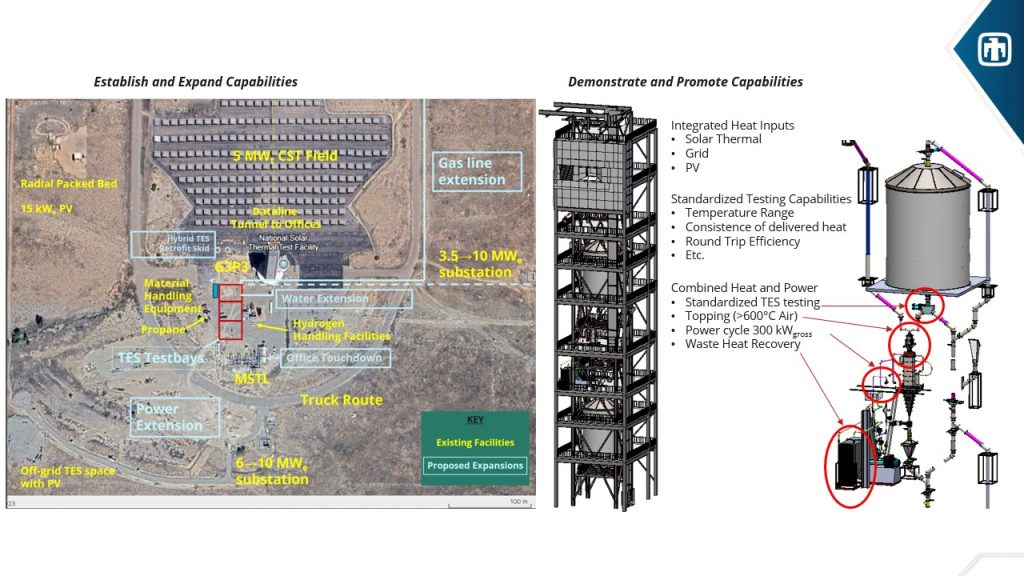
The existing TES-related assets at the NSTTF in yellow and the proposed infrastructure enhancements in blue. The enhancements include running a gas line extension, upgrading electrical capacity, and extending water supply and fiber-optic lines to the test bays.
The project aims to advance TES solutions for industrial adoption, accelerating the development of technologies that optimize thermal processes, improve energy efficiency, and enhance U.S. industry competitiveness in global markets. The project will also foster a team of research experts to ensure new lab capabilities address the complexities of various industrial sub-sectors and benefit American industry.
Contact:
Jeremy Sment, TESBed Principal Investigator
jsment@sandia.gov
Henk Laubscher, TESBed Researcher
hlaubsc@sandia.gov
Approximately one quarter of the United States’ emissions are generated through the combustion of fossil fuels to create heat. These processes can include pasteurization, drying, roasting and textile manufacturing. When heat is the end use, storing renewable energy as heat can be far cheaper than electrical storage such as batteries. Packed bed thermal energy storage features a bed of gravel that is heated by a stream of renewably heated air. When the thermal energy is required, ambient air is pulled in and heated with the hot gravel. Sandia has worked with local partners to develop a packed bed thermal energy storage test facility. Currently funded projects utilizing the packed bed system include coffee roasting, asphalt heating, and greenhouse heating.
The Molten Salt Test Loop at Sandia National Laboratories is a unique, industrial-scale testing capability that allows industry, government, and academic researchers to test components in flowing, molten nitrate salts. It is one of the only industrial-scale molten salt loops in the world capable of providing 600o C / 600 GPM operation with a 1.4 MWth cooling capacity and 6-inch inside diameter pipe size. It is currently in a frozen, shut-down state. Significant industry research and development interest exists to have MSTL re-started to de-risk research and development costs across several industries, particularly for Generation 2 and advanced concentrating solar thermal power technologies. Sandia’s team plans to restart MSTL to provide a testing platform for industry groups to validate large-scale components for use in commercial operation.This project will complete the restart in two phases: 1) complete a high-level forensics evaluation of MSTL, and 2) complete the restart of MSTL for operation in FY26. Current estimated costs for the restart would be significantly less than a new equivalent system.
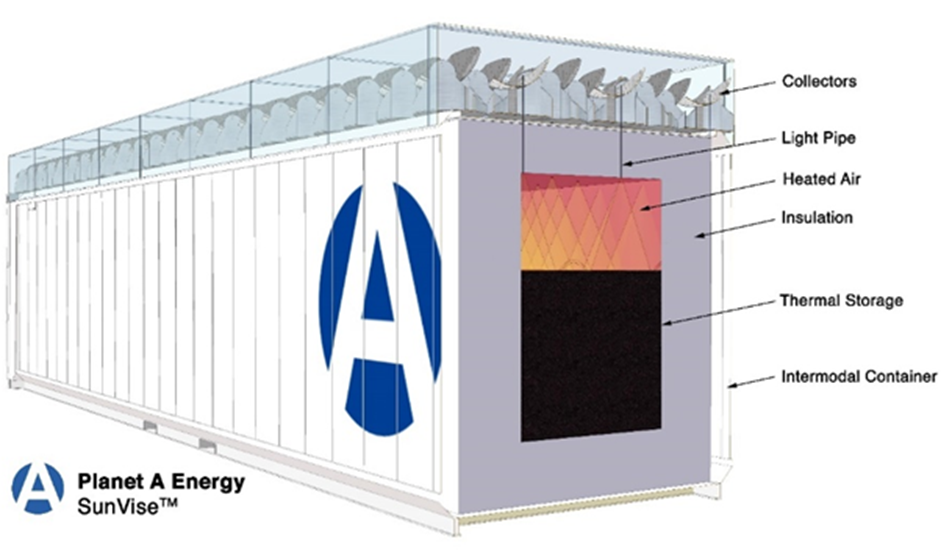
The U.S. Department of Energy’s Solar Energy Technologies Office awarded Sandia National Laboratories funding to demonstrate a prototype of individual power-added efficiency container components within an integrated system to validate predictions of techno-economic models. The Planet A Energy project will verify the technological and commercial usefulness of a grid-scale solar long-duration energy storage system that can operate either as a stand-alone industrial heat system or with an electrical generator at a concentrating solar power plant. The project will assess techno-economic analysis trade-offs between cost and performance to arrive at an optimum container design that maximizes internal rate of return or other key metrics. Sandia will also complete separate effects tests for the PAE system at the same time for confidence in an integrated system in the future. This will reduce uncertainties in the optical system, as well as PAE critical thermal processes for storage of sensible heat in a solid particle thermocline energy storage. Following optimization of the system design and establishing the operating conditions for components, the team will perform an integrated system test at process conditions of flow, temperature and pressure, but at a lower power level. PAE will complete its demonstration during the first stage of the project and proceed to develop and validate a higher system during the next stage.
The containers include a set of concentrating solar power solar collectors on top that concentrate up to 750x and deliver heat to the interior of the container where the heat is absorbed in a bed of black sand. The PAE containers are conceived as being able to support 24-hour, seven days a week, year-round energy delivery, as well as intermittent higher-power energy delivery when used as a firming resource. At that duration, each container with 28 m2 can collect and deliver an average of 4.5 kWth continuously, with the state of charge varying seasonally due to an integral of seasonal direct normal irradiance. The exact amount of continuous energy available depends on insulation performance and average length of storage. With very long storage duration, this may drop by as much as 40% depending on insulation. The team will assess optimal insulation employment with respect to cost, overall system size, and weight. Higher-power intermittent energy delivery scenarios would potentially show spikes in the state of charge. A single container charged to 800° C with a 288° C inlet temperature has a storage capacity of 15 MWhth.
Further support would promote design for a commercial system with sufficient definition to solicit cost quotations from equipment suppliers. Successful prototype demonstration will attract additional investment from public and private sources for a larger pilot-plant, a prerequisite for commercializing the technology. The end-of-project goal is to achieve technology and commercial readiness with a final estimated levelized cost of energy of <$0.07/kWh.
TESBed Seeks Input From Industry Stakeholders
Sandia has established seven technical advisory groups to coordinate and facilitate input from industry on key topics. The team has already consulted with dozens of industry contacts who chose to participate in working groups to advise on the proposed TESBed design. Scan the QR code or visit our TESBed Survey to share your industry needs with the research team.

Partners




Contact
Margaret Gordon, Solar Thermal Technologies
megord@sandia.gov
Rob Keene, National Solar Thermal Test Facility
rskeene@sandia.gov