
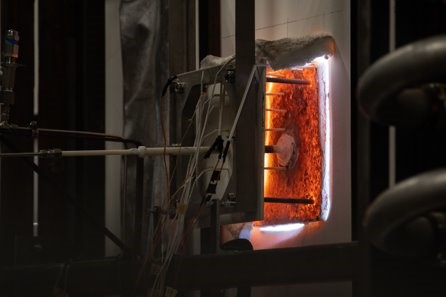
Extreme Environments Testing
The National Solar Thermal Testing Facility uses the power of the sun to create extreme combined thermal environments for advanced thermal research and testing.
One-of-a-Kind Facility
The National Solar Thermal Test Facility’s extreme environments complex is at the forefront of innovation, providing critical insights and solutions for the solar energy industry. We use the sun to simulate a range of high temperatures, extreme solar flux levels, and varying pressure or vacuum environments, allowing us to develop and validate thermal technologies under the most demanding conditions.
These unique capabilities allow government and industry partners test, validate, characterize, and demonstrate their materials and components for concrete, steel, agricultural, aerospace and other applications.
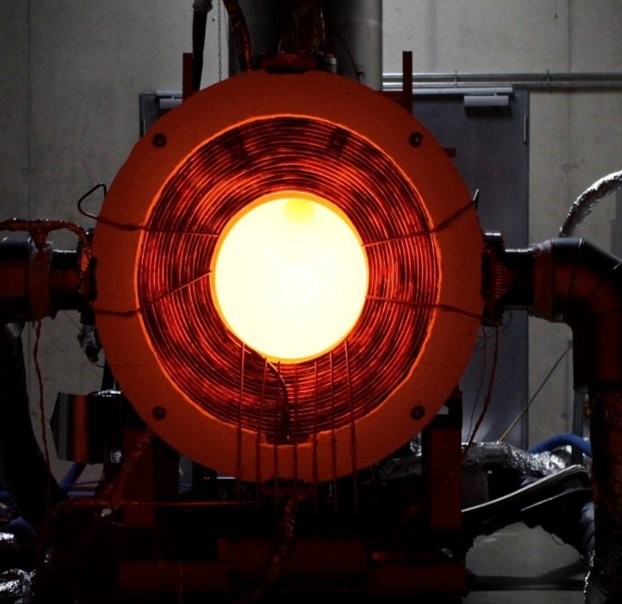
Extreme Sites
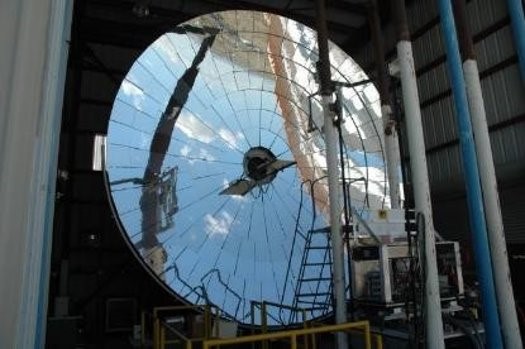
The NSTTF solar furnace uses a heliostat to reflect the suns light off a concentrator dish. This provides a renewable source which is capable of a wide range of high flux test scenarios, thermal model validation tools, and extreme environments. To protect equipment, this dish is in a fixed configuration inside an open-sided building. A heliostat reflects the sun through an attenuator to control the amount of solar flux on target.
Current features and capabilities:
- Peak irradiance of 600 watts per square centimeter
- Maximum temperatures near 3,000 degrees Celsius
- Spot size: 5 centimeters or 3 inches
- 300 psig solar reactor for gas distribution
- 1 torr vacuum solar reactor
- 50,000 frame rate UHF camera system
- FTIR photometrics for onboard spectroscopy
- FLIR camera (−20 degrees Celsius to 2,000 degrees Celsius)
- Up to 32 thermocouples
- 12 channels for voltage and current measurement
- Programmable flux profiles via attenuator
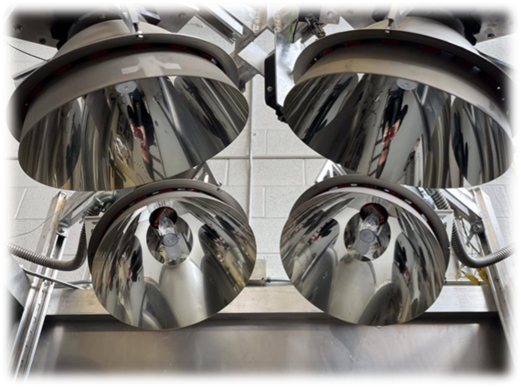
Our extreme testing site includes a one-of-a-kind, high-flux solar simulator with an Automated Sample Handling and Exposure System (ASHES), providing accelerated lifetime aging tests for materials under high-temperature/high-flux conditions. A robotic sample-handling system can be used to move multiple coupons automatically into and out of the concentrated flux sequentially to expose the samples to predetermined temperatures, fluxes, and/or durations.
Current features and capabilities:
- Peak irradiance is approximately 1.1 megawatts per square meter (130 watts per square centimeter).
- Average irradiance of approximately 0.9 megawatts per square meter over a spot size of approximately 1 inch (2.5 centimeters).
- Spot size: 2.5 centimeters.
- 24/7 operation available.
- Programmable Sample System (ASHES).
A new vertical simulator also is in development to reach 500 watts per square centimeter.
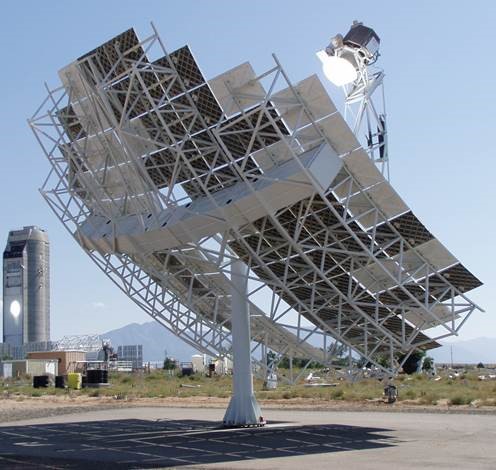
Our 36-foot diameter dishes each produce 75 kilowatts of thermal power and peak fluxes up to 1,500 watts per square centimeter. They are individually controlled to track the sun with two-axis control.
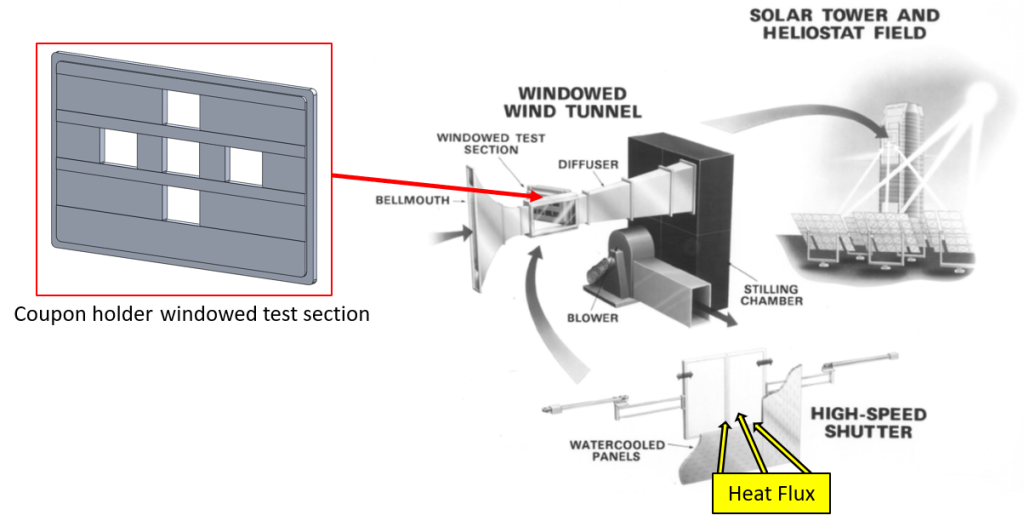
The NSTTF Solar Tower has a 0.3 Mach blow-down wind tunnel with a variable frequency drive capable of flow modulation, used to hold test articles during experimentation. The system contains a test panel made of aluminum 6061-T6 alloy, which was developed to hold multiple coupons of refractory sheet low-expansion insulation squares that include two high-speed and slow-speed flux gauges. The wind tunnel utilizes air or nitrogen gas as the working fluid, with the flow progressing from east to west within the test section, maintaining a standoff between the coupon and the wind tunnel inlet. Additionally, the system comprises two sets of large shutters to facilitate flux-pulsed experimentation down to 0.1-second pulse widths. The test section includes quartz glass to allow flow, which can be monitored in real time. The experimental test panel includes RSLE insulation tiles with high-speed flux gauges and a temperature-compensated radiometer to characterize the Gaussian flux profiles incident during each respective test exposure.
Work with us
We partner with large and small businesses, universities, and government agencies. With multiple agreement types to select from, partners can access world-class science, engineering, experts, and infrastructure.
Contact
Robert Keene, National Solar Thermal Test Facility
rskeene@sandia.gov