
Rural and Agricultural Income and Savings from Renewable Energy Initiative (RAISE)
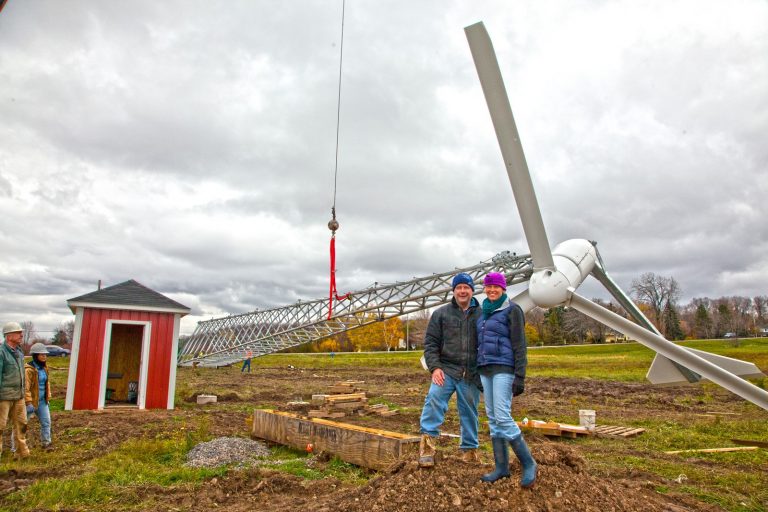
To help rural small businesses, farmers, and electric cooperatives cut costs and increase income, the U.S. Department of Energy and the U.S. Department of Agriculture created the Rural and Agricultural Income and Savings from Renewable Energy initiative using smaller-scale renewable energy projects and underutilized technologies, such as on-site, distributed wind turbines. The RAISE project is a multi-lab effort between Sandia National Laboratories, Pacific Northwest National Laboratory, National Laboratory of the Rockies, and Idaho National Laboratory.
Through the RAISE initiative, rural electric cooperatives, agricultural associations, farmers unions, and financial services providers develop networks of stakeholders to educate, research, and provide technical assistance to small- and medium-scale farm owners. These partners work with and support the development of new business models that deliver economic benefits to rural and agricultural entities.
The RAISE initiative aims to enable farmers to keep farming and preserves farmland while also generating new revenue streams and enjoying the benefits of locally generated energy.
Sandia’s Contributions:
- Valuation of Distributed Wind for Agricultural Applications: Sandia National Laboratories is conducting research to assess the economic benefits and costs associated with distributed wind energy systems in agricultural settings. This work aims to provide farmers with a clearer understanding of how distributed wind can enhance their operations, improve resilience, and generate additional income through energy sales. By quantifying the value of distributed wind, Sandia helps stakeholders make informed decisions about investments in renewable energy.
- Interconnection Challenges for Deployment in Agricultural Sectors: Sandia is also addressing the technical and regulatory challenges associated with the interconnection of distributed wind projects in agricultural contexts. This includes identifying barriers to adoption, such as the need for costly grid upgrades and compliance with stringent regulations. Sandia’s research highlights the unique characteristics of wind energy generation, such as its variability and intermittency, which can complicate interconnection processes. By collaborating with stakeholders, Sandia aims to develop solutions that facilitate the deployment of distributed wind technologies in rural areas, ensuring that farmers can benefit from onsite energy generation.
Impact on Rural Communities
Through the RAISE initiative, farmers can continue their agricultural practices while preserving farmland and generating additional income from renewable energy projects. By promoting locally generated energy, the initiative not only contributes to the economic resilience of rural communities but also fosters a secure energy future.
The RAISE initiative exemplifies a commitment to empowering rural areas, ensuring that they can thrive economically while embracing renewable energy solutions.
Resources
Work with us
We partner with large and small businesses, universities, and government agencies. With multiple agreement types to select from, partners can access world-class science, engineering, experts, and infrastructure.
Partners
National Laboratory of the Rockies
Pacific Northwest National Laboratory
Contact
Rachid Darbali-Zamora, Principal Investigator
rdarbal@sandia.gov