
Interconnection Innovation e-Xchange (i2x)
In 2023, the U.S. Department of Energy’s Wind Energy Technologies Office awarded Sandia National Laboratories three Interconnection Innovation e-Xchange (i2x) program projects to examine ways to avoid grid performance issues and address system integration challenges for distributed wind. The award included proposed work for:
- A hosting capacity project, which focused on a study of tradeoffs between distributed wind and solar
- An unintentional islanding detection project, which examines UI detection for a type-I wind turbine generator using the commercial feeder protection relay SEL-751
- An assessment of the value of distributed wind with New York’s Value Stack Tool
Hosting Capacity Analysis
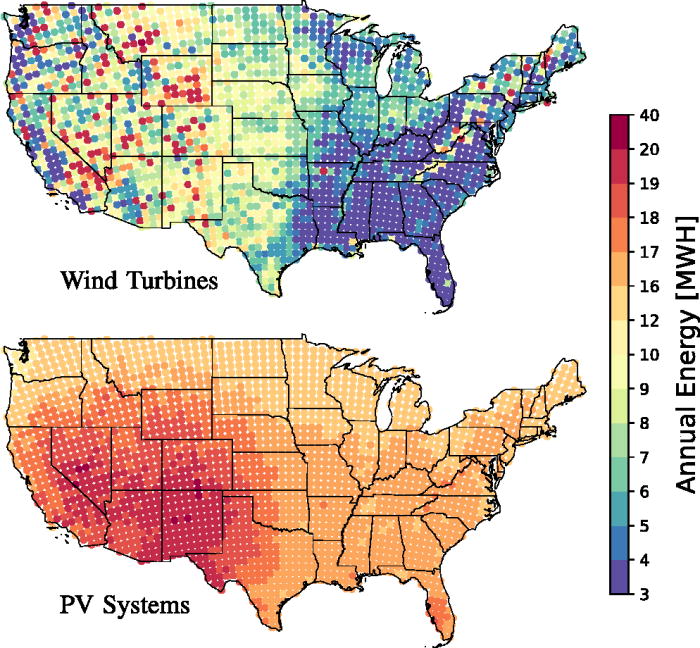
Significant numbers of small-scale wind turbine generators are connecting to U.S. distribution grids, with one 2022 report citing over 90,000 turbines currently producing power and 919 GWs of behind-the-meter installations expected by 2035. Wind’s counterpart, photovoltaic or solar power, currently has a much larger share of the market, with an estimated 38 GW of solar power currently on distribution grids. As the amount of combined energy continues to grow, the chance of over-saturation and damage to electric power systems on distribution grids increases.
Sandia quantified and grouped locations based on the renewable energy generation availability, reliability, variability and cooperative operations. The method’s threshold-based parser quantifies locations across a region or country using the following metrics:
- Availability — The amount of energy produced by solar or wind resources over an entire year
- Reliability — The consistency or day-to-day variability of solar and wind resources
- Variability — Natural changes in renewable energy resource outputs at intra-day intervals
- Coincidence — The complementary characteristics of wind and solar resources that improve or hinder the integration of the renewable resources
This methodology assists a number of wind industry stakeholders:
- Energy planning and policy developers can make informed strategies to implement supportive polices and incentives
- Grid planners and operators can anticipate the characteristics and potential variability of variable generation in different regions. This allows for improved preparation, and utilities can take an active approach to optimize the deployment of wind and solar resources so that they complement each other and/or directly support the electric grid’s needs
Resources
Buffalo Renewables works with rural businesses, small businesses, and farms to make renewable energy affordable. The company specializes in designing, installing and maintaining custom renewable energy solutions like solar and wind to help clients achieve energy independence and eliminate their energy costs. Buffalo Renewables provides end to end support for all aspects of projects, including system design, local permitting, grant applications, installation, and continued operation and maintenance support for the life of the system. Learn more about Buffalo Renewables.
Unintentional Islanding Detection
Unintentional islanding detection is crucial for the reliable and stable operation of a power system, particularly in areas where wind turbine systems are widely deployed. Wind farms and turbines are designed to remain connected to the grid and are not permitted to disconnect in the event of a disturbance or failure.
Inaccurate unintentional islanding detection can have negative consequences for customer and utility equipment integrity. Even if the unintentional islanding period is short, system stability remains a concern. As a result, unintentional islanding detection is one of the major issues taken into account in national grid codes and international standards.
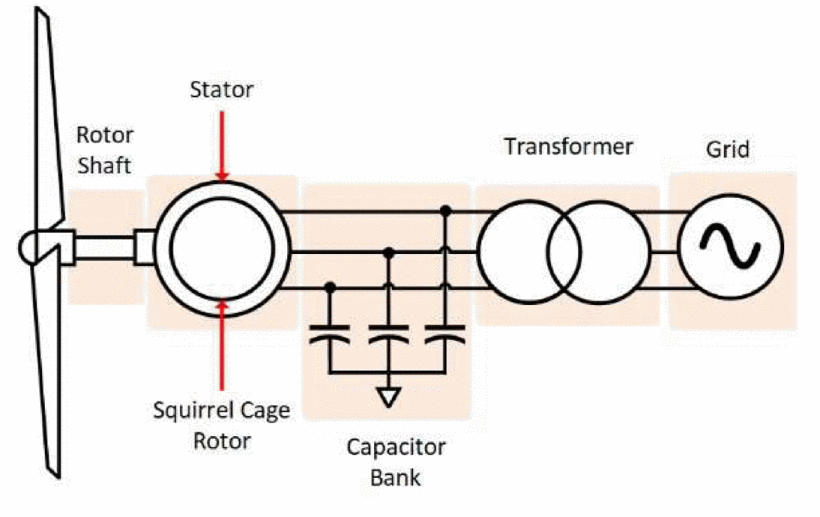
Sandia’s unintentional islanding study validated the Siva type-I wind turbine generator field data collected from the installation site and assessed the capability of the SEL-7 51 feeder protection relay for unintentional islanding detection in a system with type-I wind turbine generator connected to the grid.
Project contributions include:
1) A MATLAB/Simulink model of a commercially available type-I wind turbine generator, Siva 250/50, developed and was validated with field data
2) A hardware-in-the-loop test bed evaluated the unintentional islanding detection functionality of a commercial feeder protection relay SEL-751
3) The performance of SEL-751 under various islanding scenarios was tested and the results were provided.
Resources

Established in 2020, and headquartered in Buffalo, New York, Siva Powers America focuses on optimizing the Siva system for the North American market and establishing a strong domestic manufacturing facility. Read more about SIVA Powers America.
Distributed Wind Valuation
Sandia National Laboratories examined New York’s Value Stack method to better understand its application to distributed wind energy. The project aimed to address several key goals: to enhance understanding of the Value Stack framework, to demonstrate the challenges associated with applying this method to wind energy, to suggest future considerations for improving the Value Stack, and to highlight the potential impacts of these considerations on the valuation of wind energy.
One of the primary challenges identified in evaluating wind energy with the Value Stack is that the current calculator is primarily designed around solar generation and peak summer demand. As a result, wind energy often demonstrates a lower value in the current framework. To address this, the project suggested altering the demand reduction value windows to account for future winter peaking, which could enhance the valuation of wind energy due to its generation during peak winter hours.
The findings from this collaboration indicated that by adjusting the Value Stack methodology, wind energy could become more valuable, particularly in regions experiencing a transition to winter peaking. This project underscores the importance of refining valuation methods to better reflect the contributions of distributed wind energy in the evolving energy landscape.
Resources
Buffalo Renewables works with rural businesses, small businesses, and farms to make renewable energy affordable. The company specializes in designing, installing and maintaining custom renewable energy solutions like solar and wind to help clients achieve energy independence and eliminate their energy costs. Buffalo Renewables provides end to end support for all aspects of projects, including system design, local permitting, grant applications, installation, and continued operation and maintenance support for the life of the system. Learn more about Buffalo Renewables.
Work with us
We partner with large and small businesses, universities, and government agencies. With multiple agreement types to select from, partners can access world-class science, engineering, experts, and infrastructure.
Contact
Rachid Darbali-Zamora, Principal Investigator
rdarbal@sandia.gov