
As the world seeks reliable and affordable energy solutions, harnessing the power of ocean waves presents a promising opportunity. Wave energy converters (WECs) are innovative devices designed to capture the kinetic and potential energy of waves and convert it into usable electricity. However, developing effective and reliable WECs is challenging due to the diverse marine environments in which they operate and oscillate. A WEC designed for the Atlantic coast may not perform well on the Pacific coast due to differences in wave conditions, weather patterns, and seabed characteristics. This variability necessitates tailored designs, which is where reference models and co-design approaches come into play.
What are reference models?
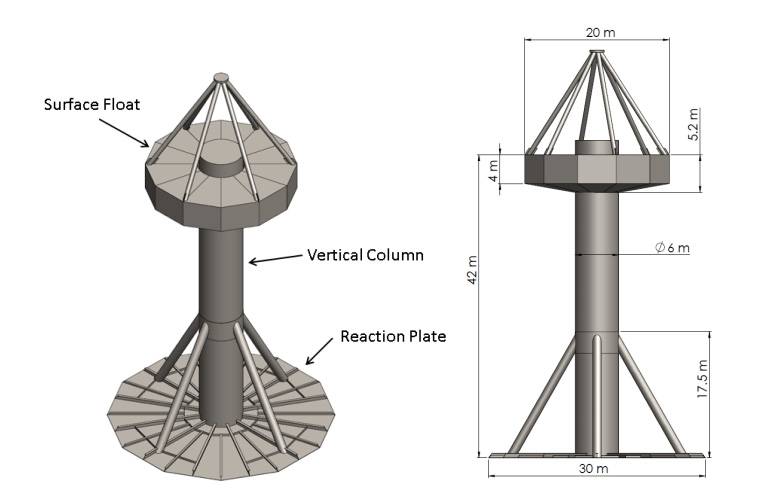
Reference models are standardized designs intended to provide open-source frameworks for evaluating and comparing different marine hydrokinetic designs, including WEC technologies. These models simplify the development process by providing a common foundation, such as key design parameters, performance metrics, and cost estimates. Reference models are essential for fostering innovation while ensuring consistency across research and development efforts in the wave energy sector.
One prominent example is the Reference Model Project sponsored by the U.S. Department of Energy’s Water Power Technologies Office (WPTO) and led by Sandia National Laboratories in conjunction with the National Renewable Energy Laboratory (NREL), Pacific Northwest National Laboratory (PNNL), the Applied Research Laboratory of Penn State University, and Re Vision Consulting. At a time when almost all developed marine energy systems were private, proprietary designs, the Reference Model Project produced six open-source concepts to encourage widespread experimentation and adaptation. Recently, researchers at Sandia undertook a redesign of the third reference model, RM3, to showcase co-design in WEC-development.
The role of control co-design in WEC development
In previous efforts, Sandia and NREL used a technology performance level assessment to examine the design of RM3. They discovered that the RM3 design was not economically viable because the cost of the steel used in its construction exceeded the market value of the electricity it could generate. This led Sandia and NREL to set a new performance goal focused on increasing the amount of electrical power produced per unit of surface area in the redesigned RM3. Their goal was to show how control co-design could make the system more cost-effective and practical for real-world use.
Control co-design is an approach that integrates multiple subsystems in the design optimization of the overall system. In a wave energy system, it is crucial that the hydrodynamics, power-take-off, and control systems are designed concurrently to efficiently convert the kinetic and potential energy from the waves into usable electricity. Design decisions can affect all three subsystems; therefore, a robust mathematical framework was developed and implemented using the Sandia-developed WecOptTool to optimize the design parameters for the entire system. Researchers also considered the cost of each optimized parameter set. For instance, they evaluated the decreased energy captured from a smaller RM3 WEC against the increased manufacturing and maintenance costs for a larger design. Researchers successfully developed a method for designing WECs that maximizes power output while minimizing energy costs. This was achieved by integrating control co-design principles, using real-world cost data, and applying design parameters that optimize performance. The new method follows state-of-the-art design practices that minimize the cost of energy.
The synergy between reference models and co-design
Reference models are a familiar starting point for wave-energy developers. By updating their designs using best-available control co-design approaches, Sandia researchers have provided developers with a demonstrated example transferable to other WECs. A more detailed look at how RM3 was optimized can be found in From TPL assessment to design optimization: Wave energy converter control co-design applied to the RM3.
This work was funded by the U.S. Department of Energy’s Water Power Technologies Office.
September 10, 2025