
Tower-based power systems
Solar Tower One
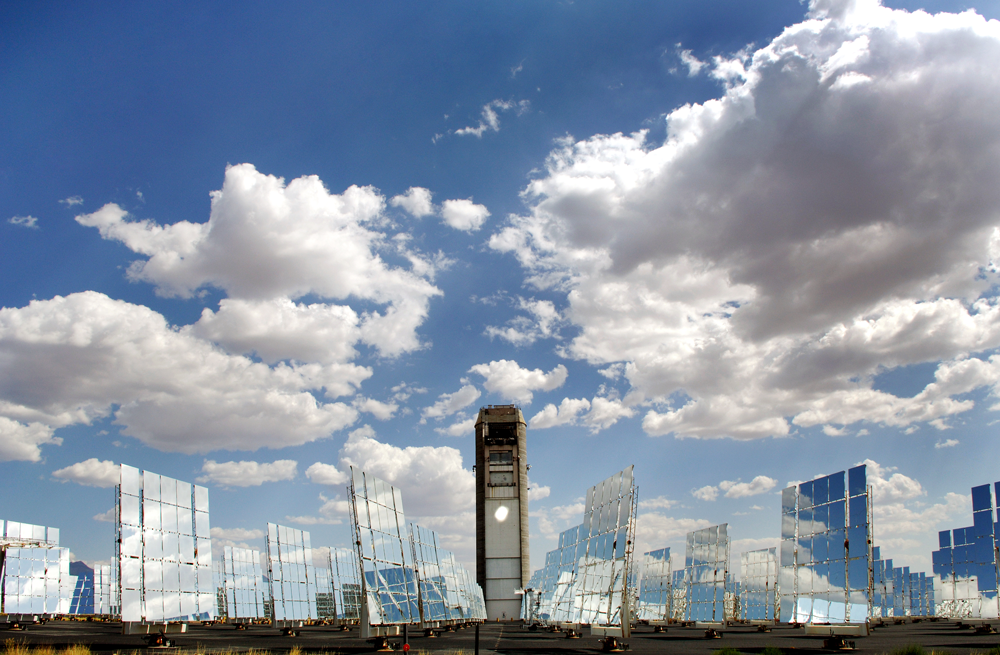
NSTTF Resources
- Four 350 sq. ft. test bays
- One 750 sq. ft. test bay
- Elevating module brings tests from ground level to bay/roof
- Heat rejection system at each test bay
- Analog and digital data logger with multiple channels with variable frequency control
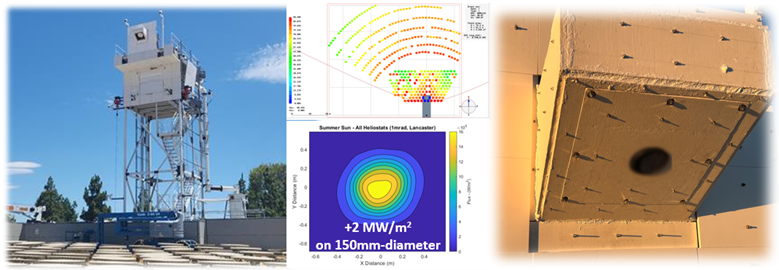
The 218 high-quality, individually computer controlled heliostats can produce high flux on target on the tower. The heliostats are also used for astronomy experiments, high temperature transient tests, material testing, thermo-nuclear test simulations, or radiation hardening experiments.
This site provides setup and testing heliostats with special canting and focusing requirements. Various optical tools are available to cant and focus heliostats for various applications, including tracking and canting heliostats for near-earth stationary objects in space.
The 2,500-square-foot warehouse/assembly building comes with a 34-foot ceiling. The building includes a 5-ton mobile crane with a 24-foot lift, welding, and machining tools.
Generation 3 Particle Pilot Plant (G3P3)
As part of a $70 million multi-year U.S. Department of Energy Generation 3 CSP Systems program that began in 2018, the U.S. Department of Energy announced a Phase III, $25 million award to Sandia National Laboratories to build, test and demonstrate a next-generation concentrating solar thermal power (CSP) plant at the National Solar Thermal Test Facility (NSTTF) in Albuquerque, New Mexico. The award was announced on March 25, 2022, during a webinar hosted by DOE.
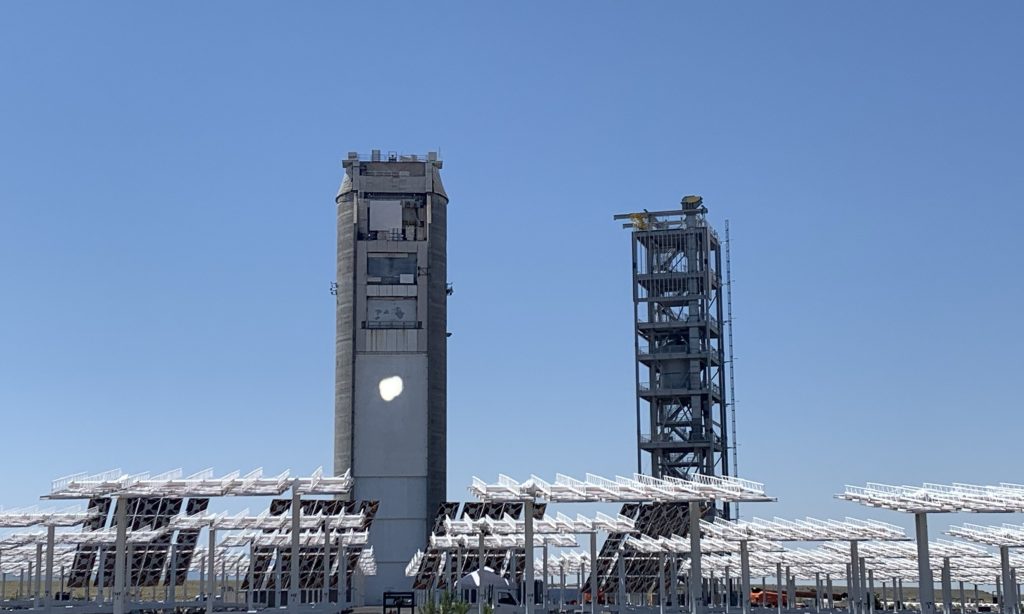
The objectives of the G3P3 project are to design, construct, and operate an integrated system that de-risks a next-generation, particle-based concentrating solar power technology to produce utility-scale electricity with long-duration energy storage. The proposed multi-megawatt (MW) G3P3 system will utilize the existing field of heliostats at Sandia’s National Solar Thermal Test Facility to concentrate the sunlight to a particle receiver that heats particles to over 700 degrees Celsius, enables at least six hours of particle-based energy storage, and heats a working fluid (e.g., supercritical carbon dioxide or air) to 700 degrees Celsius or higher while demonstrating the ability to meet cost and performance goals.
Particle receivers are being pursued to enable higher temperatures (greater than 700 degrees Celsius) with direct storage for next-generation dispatchable CSP plants, process heating, thermochemistry, and solar fuels production. Unlike conventional CSP receivers that use fluids flowing through tubes, the proposed particle-receiver system uses solid particles like ceramic or sand that are heated directly as they fall through a beam of concentrated sunlight. Once heated, the particles are stored in an insulated bin before passing through a particle-to-working-fluid heat exchanger to power a high-efficiency Brayton cycle (e.g., supercritical carbon dioxide or air). The cooled particles are collected and then lifted back to the top of the receiver.
The success of this work will retire the primary risks associated with particle receivers and enable the successful demonstration of a high-temperature particle pilot plant that meets the U.S. Department of Energy’s SunShot goals with thousands of hours of on-sun testing. Successful operation of G3P3 will lead to broader acceptance, deployment, and commercialization.
In Phases 1 and 2, Sandia successfully de-risked key elements of the proposed G3P3 by improving the design, operation and performance of key particle component technologies including the receiver, storage bins, particle-to-supercritical carbon dioxide heat exchanger, particle lift and data acquisition and controls. Modeling and testing of critical components led to optimized designs that meet desired performance metrics. Detailed drawings, piping and instrumentation diagrams, and process flow diagrams were generated for the integrated system, and structural analyses of the assembled tower structure were performed to demonstrate compliance with relevant codes and standards. Instrumentation and control systems of key subsystems were also demonstrated. Together with Bridgers & Paxton, Bohannan Huston Inc., and Sandia Facilities, a 100 percent G3P3 tower design package with stamped engineering drawings suitable for construction bid was developed.
The contract for G3P3 was awarded to Summit Construction in August 2022. The tower was erected between January 2023 and April 2024. As of December 2024, the particle-based solar components have been lifted into the tower and are being assembled and energized. The 2-megawatt thermal falling particle receiver has been ground tested with particles at ambient temperature. The storage bins have been installed. The storage bin insulation is nearing completion using a combination of microporous insulation, calcium silicate and high-alumina silica firebrick with thermocouples embedded between each layer. The heat exchanger is being fabricated and will be received in early 2025. The supercritical carbon dioxide circulating loop has been successfully ground tested and is being assembled in the tower by NSTTF technologists. All particle ductwork and control valves are being installed and initialized.
Related G3P3 Projects:
Sandia is investigating a major solar energy deployment capable of providing 100% of the combined energy needs of Kirtland Air Force Base, including Sandia National Laboratories and National Nuclear Security Agency tenants. In 2024, a computational model was developed on Sandia’s high-performance computing infrastructure to run advanced energy balance calculations to determine how much solar energy could be harvested on available KAFB land. The outcome of this analysis determined that the lowest-cost and highest-yield system would be hybrid, with daytime photovoltaic energy generation that delivers AC power directly to the Sandia grid and converts all excess DC power above the current load to lithium-ion batteries. Once the batteries are fully charged, any remaining PV energy is converted to heat that is stored in a particle-based thermal energy storage system. Additionally, a concentrating solar power plant will be used to provide low-cost heat to the TES system during the day.
A FEED study was commissioned by the Solar Energy Technologies Office at the U.S. Department of Energy to reduce cost and deployment uncertainty associated with the first-of-its-kind particle-based CSP system at this scale. The scope of the study will involve down-selection of the key technology options for the CSP portion of the project, such as the type of turbine and heat exchanger, and work with an engineering, procurement, and construction firm to better estimate the cost of tower construction, field deployment, storage bin construction, and system integration. The study will also establish a supply chain by submitting drawings and specifications to vendors, and where no vendor currently exists for first-of-its-kind components, such as falling particle receivers, we will provide fabrication drawings to custom vendors.
Supercritical CO2 Brayton power cycles used in Generation 3 concentrating solar power require a heat exchanger that can deliver heat to the sCO2 from the particle thermal energy storage and heat transfer fluid. This heat exchanger is typically made from exotic and expensive alloys due to the high temperature and pressure operating conditions. The goal of the Compact Counter Flow Fluidized Bed Heat Exchanger project is to increase the particle-to-sCO2 heat transfer coefficient relative to the current state-of-the-art heat exchange design to decrease the cost and improve the performance of the component. The project features Babcock & Wilcox and TU Wien as project partners.
The Heliostat Consortium for Concentrating Solar Thermal Power, or HelioCon, was established by the U.S. Department of Energy’s Solar Energy Technologies Office to improve CSP components for the concentrated solar-thermal power industry. Member organizations include the National Laboratory of the Rockies, (lead), Sandia National Laboratories, and the Australian Solar Thermal Research Institute (ASTRI). Together, these organizations perform research and development activities to validate, commercialize, and deploy low-cost and high-performance heliostats. The goal of these activities is to optimize operations and maintenance for concentrating solar power and concentrating solar-thermal applications.
HelioCon objectives include:
- Developing strategic core capabilities and infrastructure to support high-performance heliostat manufacturing, validation, and optimization and facilitate industry’s ability to design, manufacture, install, and operate central receiver heliostat fields with higher technical and economic performance
- Ensuring that these capabilities are readily available to industry, and meeting their needs
- Funding research on new technologies with significant potential to improve heliostat field economic performance
- Forming U.S. centers of excellence focused on heliostat technology to restore U.S. leadership in heliostat research, development and validation
- Promoting workforce development by encouraging student internships and postdoctoral positions, the formation of a HelioCon early career scientist group to promote networking, and highlighting existing training and educational programs in heliostat design, production and operation.
In order to remove commercial risks, improve economic competitiveness, and attract additional investors, HelioCon’s first step was to conduct a roadmapping study to identify and address technical and nontechnical gaps that limit the development of low-cost, high-performance heliostat technologies with minimized annual operation and maintenance expenses.
In September 2022, HelioCon released the Roadmap to Advance Heliostat Technologies for Concentrating Solar-Thermal Power, to guide heliostat research and deployment.
Contact: Margaret Gordon
Generation 3 concentrating solar power systems can use solid particles as the heat transfer and thermal energy storage medium. While these particles have a number of benefits as a heat transfer fluid, including high durability, low potential for environmental harm, low cost, and high energy density, they can be highly abrasive to the materials containing them. Valves, ducting, lifts, heat exchangers, and storage bins are exposed to high-temperature flowing particles for decades, leading to concerns about the lifetime of these components. The goal of the High Temperature Particle Recirculation Test Loop (HotPROP) project is to develop a system that can continuously flow 800-degree Celsius particles at 25 kg/s over hundreds of hours to assist with the characterization of particle handling component lifetime.
The Long-Term Particle Wear project investigates surface wear in packed bed and fluidized bed particle systems at high temperatures for concentrating solar power-relevant materials and uses that data to validate numerical models that can predict material lifetimes for given temperature and particle flow regimes. Using solid particles as energy storage and transfer media is seen as one of the most practical ways to achieve the temperature targets needed to drive advanced high-efficiency power cycles and generate alternative fuels via solar thermochemistry while simultaneously driving down the cost of thermal energy storage. However, one of the biggest engineering challenges of next-generation concentrated solar power plants is the handling of bulk materials at elevated temperatures. The current particle of choice for Sandia National Laboratories’ Generation 3 Particle Pilot Plant is primarily made of sintered bauxite. These particles have excellent optical and thermophysical properties for CSP applications. They also have the potential to cause severe wear in chutes, valves, heat exchangers, and other high-temperature CSP components. These models can be used for CSP plant design where expected material lifetimes are measured in 105-106 hours. Furthermore, this project will develop two lab-scale particle wear test rigs capable of simulating accelerated particle wear and will add to the capability of Sandia’s National Solar Thermal Test Facility as a particle-based CSP research and development facility.
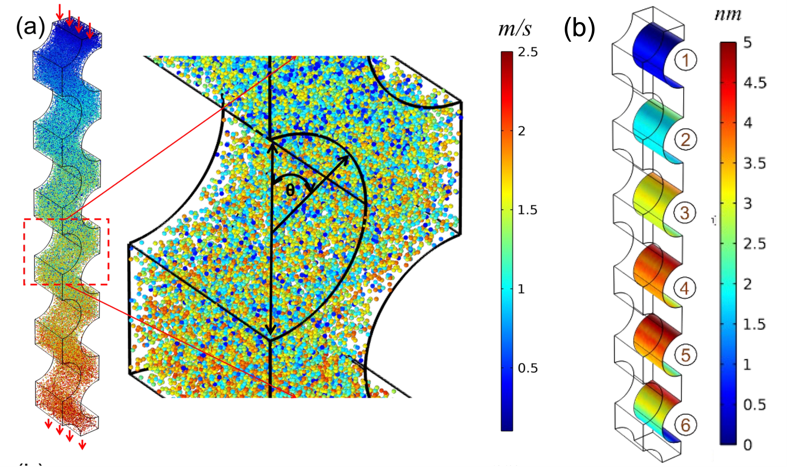
Illustrative simulations of particle trajectories between tubes in a heat exchanger and erosion wear profiles on the tube surfaces
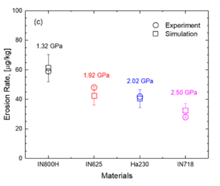
Comparison of experimental and simulation erosion rate for different materials.
Contact: Matthew Sandlin
When falling particle receivers are used to directly heat particles using concentrated solar power, they generate a particle curtain that cascades through an open cavity. This curtain can be approximately 10 meters wide and 6 centimeters thick. The goal of the Particle Curtain Generating Valve (PCGV) project is to develop a modular valve that can be strung together to create a continuous particle curtain that can span over 10 meters and operate at 900 degrees Celsius.
The U.S. Department of Energy’s Solar Energy Technologies Office recently awarded funding for a collaborative effort between General Electric (GE) and Sandia National Laboratories to design and demonstrate a techno-economically viable multi-component silicon carbide (SiC) air receiver technology to achieve 1,100 degrees Celsius gas temperature for concentrating solar thermal applications using adaptations of GE’s additively manufactured SiC and scalable SiC-based ceramic matrix composite technologies. Increasing operating temperatures of solar receivers is paramount to the efficiency of concentrating solar thermal and concentrating solar power systems. Owing to its high-temperature stability, combined with excellent thermal and optical properties, SiC—a hard, synthetic ceramic material made of silicon and carbon—has been the material of choice for application in high-temperature solar receivers. The state-of-the-art SiC volumetric concentrating solar air receivers, like the honeycomb design, have been demonstrated in field tests to achieve exit air temperatures approaching 800 degrees Celsius. However, successful application of CST systems to decarbonize the industrial sector’s use of hydrocarbon fuels to generate heat requires a significant increase in both temperature capability and SiC technology’s potential impact, competitiveness, and feasibility.
Contact: Ken Armijo
Work with us
We partner with large and small businesses, universities, and government agencies. With multiple agreement types to select from, partners can access world-class science, engineering, experts and infrastructure.
Contact:
Jeremy Sment, principal investigator
jsment@sandia.gov