
Electricity demand is on the rise both in the US and around the globe. A new Sandia report provides a comprehensive review of electricity load growth drivers, the challenges associated with these growth factors, and the proposed solutions for meeting increasing demand.
The report, “A Review of Load Growth Drivers & Associated Resource Planning Activities,” focuses on six load growth drivers: data centers, manufacturing, electrification, drinking water and wastewater, population trends, and extreme weather events. Funding for this work was provided by the US Department of Energy.
The research team used three criteria to select these six drivers — size of the load, stakeholder attention, and potential implications across multiple economic and social sectors.
“Many of these drivers are interconnected, especially in the context of economic development and utility sustainability goals,” said report author and system research analyst Thushara Gunda. “Our goal was to synthesize insights across these drivers.”
For example, both extreme weather events and electrification increase the amount of electricity needed for heating and cooling. Increased cooling needs require both more water and electricity to pump that water.
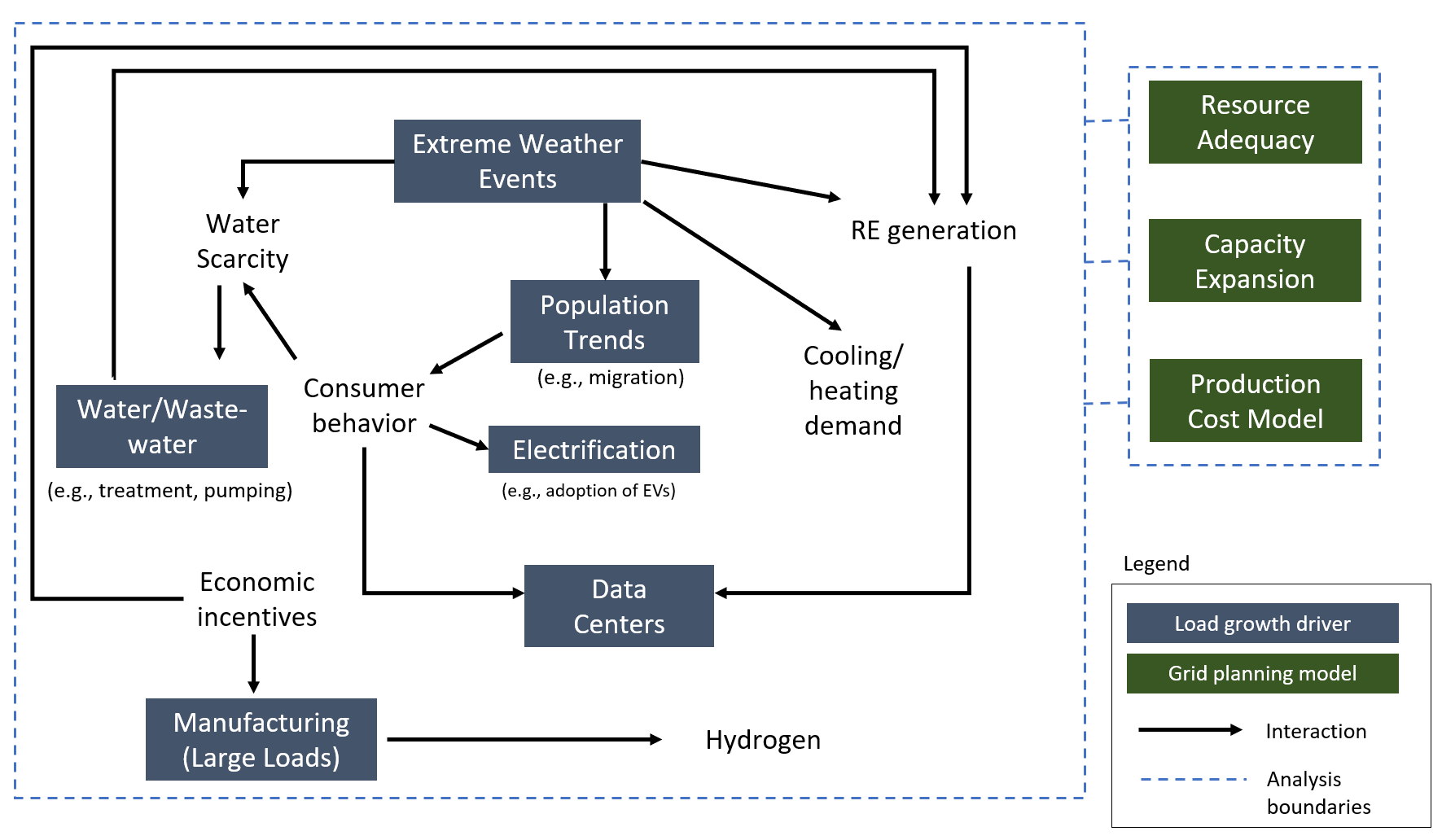
While these load growth drivers are national in scale, the research team also used a regional case study of the US Southwest to better understand potential regional differences. They found different utilities in the region face similar challenges, especially with increased demand from large industrial loads and electrification.
“All of these utilities know that the uncertainties are large when it comes to forecasting future loads and those uncertainties are just growing,” said report author Raquel Valdez.
Valdez added that the case study shows variability exists not just in the magnitude and timing of load growth drivers based on location but also in the assessment and planning for load growth among utilities operating in the same region.
The report identifies a couple of opportunities to improve load forecasting and better account for these regional factors by accounting for complex interactions in modeling and associated planning activities.
Sandia has several grid planning and modeling capabilities that could help support these activities. For example, the multi-lab North American Energy Resilience Model (NAERM) system can simulate multiple critical infrastructures, and the open-source QuEST Planning tool can identify cost-optimal energy storage, generation, and transmission investments. Sandia also works to characterize and predict impacts from natural disasters and intentional threats on critical infrastructure systems, including the electric grid.
The research team also included Kate Klise and Cody Newlun.
August 27, 2025